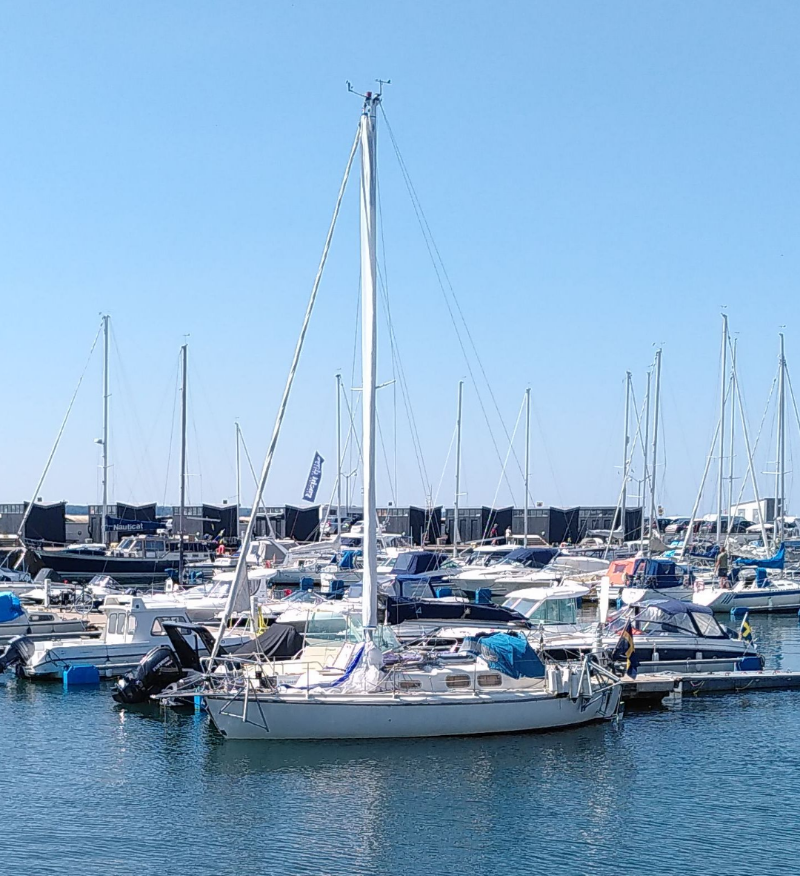
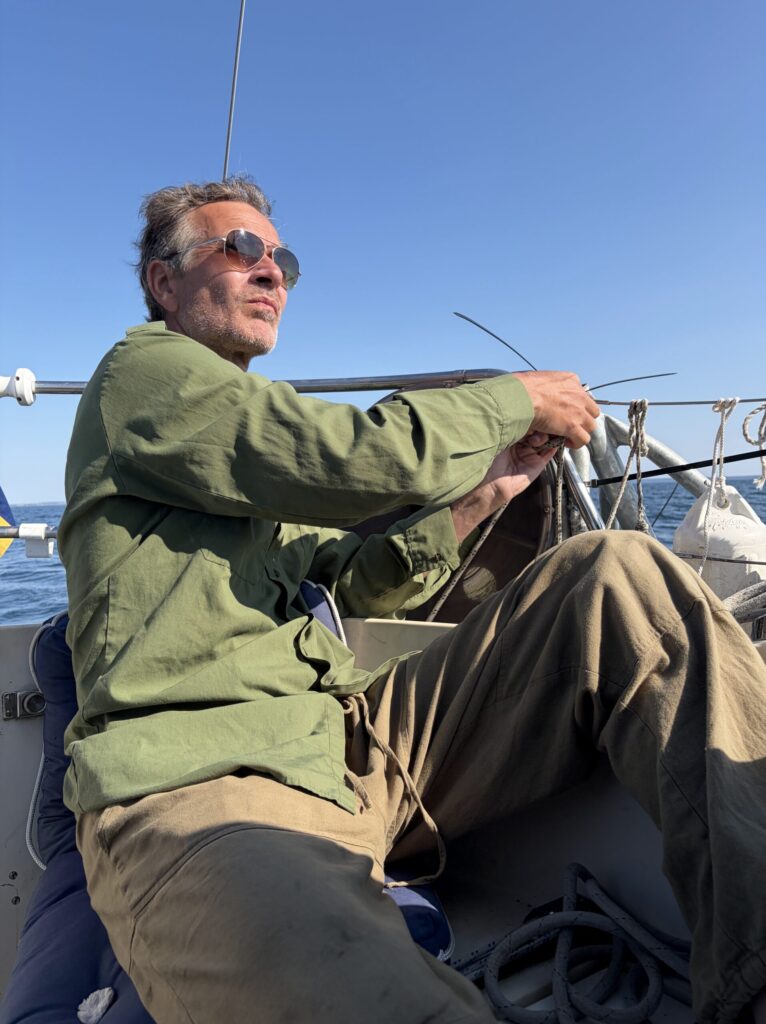
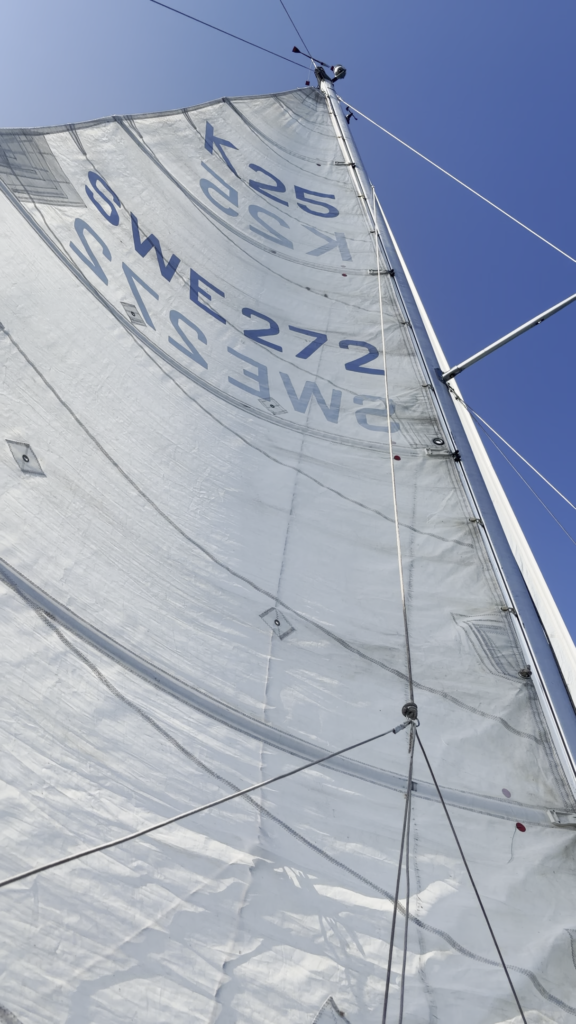
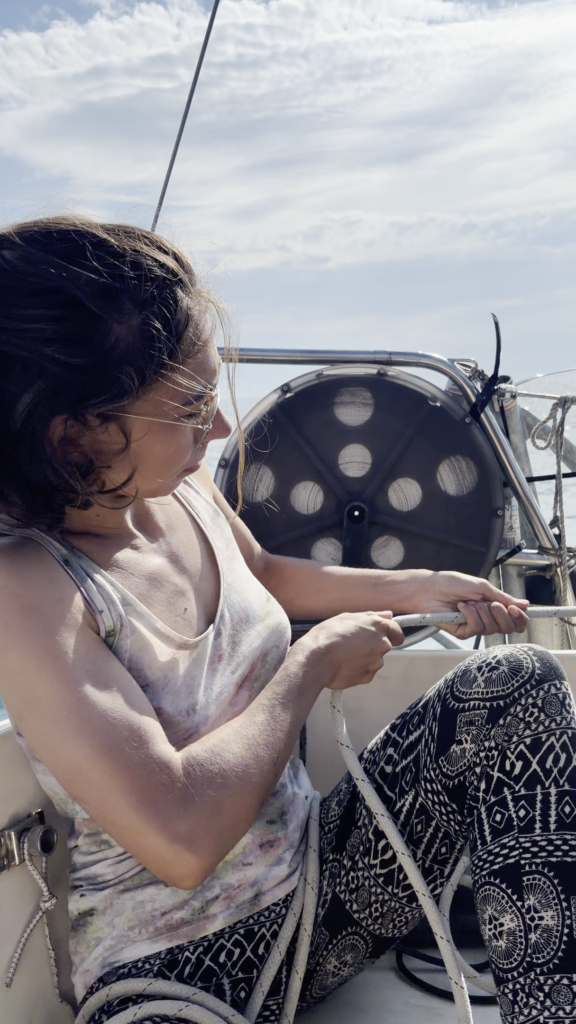
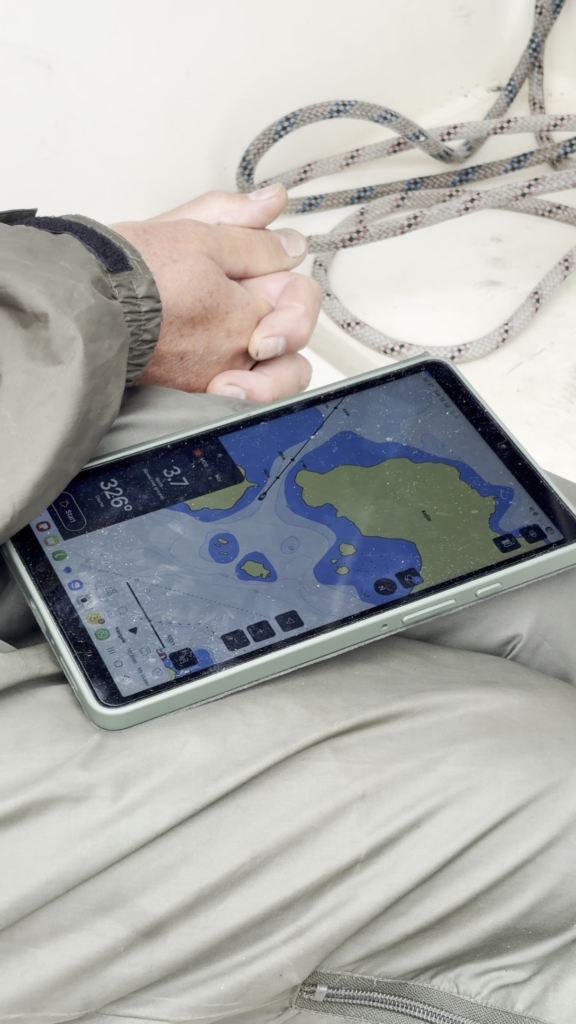
There was a man in Stockholm who had a beautiful sailing boat.
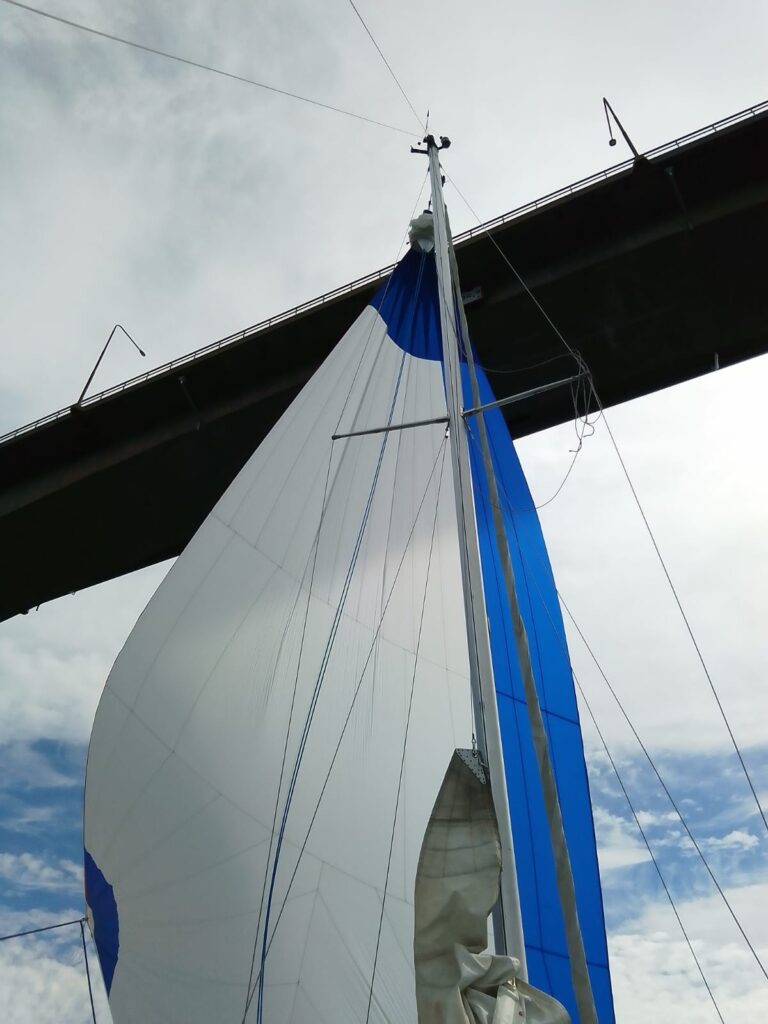
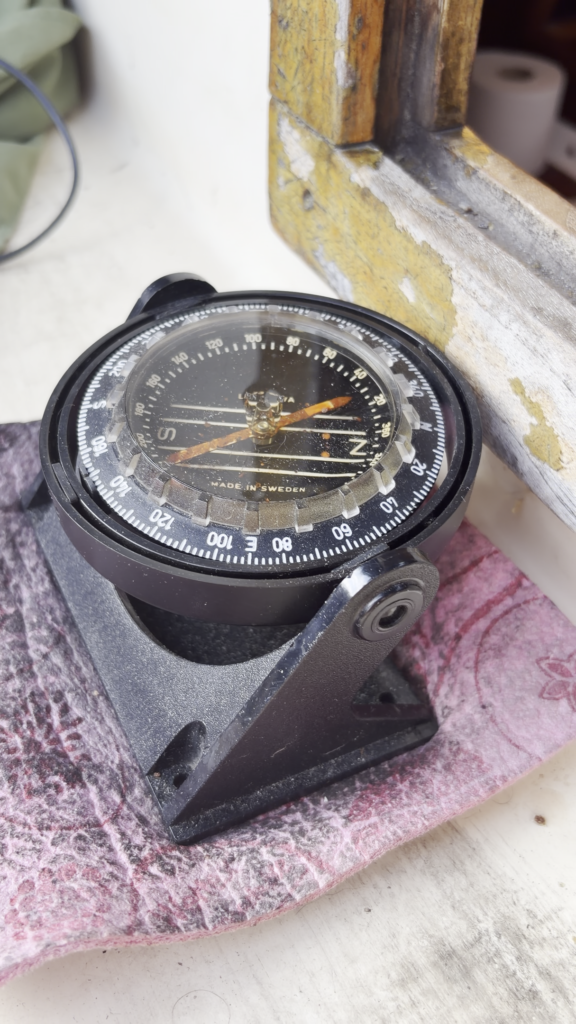
He had equipped it well: six different sails, for all kinds of weather. A GPS. An autopilot. A wind rudder. A depth sounder. Music. A VHF. Spare parts for the engine. Food in the kitchen. A carpet on the floor.
Everything was there.
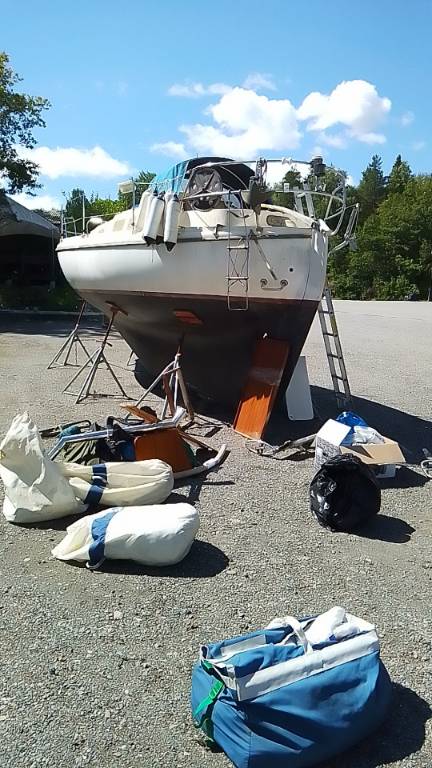
But one day, after a heavy rain, the boat filled with water.
Several years passed. Mold appeared. The engine would not start. The man had to focus on his health.
Now… he just wants to give his boat away.
The boat was found on Blocket – the Swedish second-hand online platform – by the most unlikely creature imaginable: a Hästekasen member.
For free.
The promise
A first trip to Stockholm, to meet the boat, to meet the man. He liked the fact that Hästekasen counted good sailors among its members.
The boat had some damage, but the main problems could be fixed.
The trip ended with a promise: more members would come back and the boat would be salvaged.
A few weeks later, another Hästekasian crossed Sweden on board the high-speed VR train between Gothenburg and Stockholm.
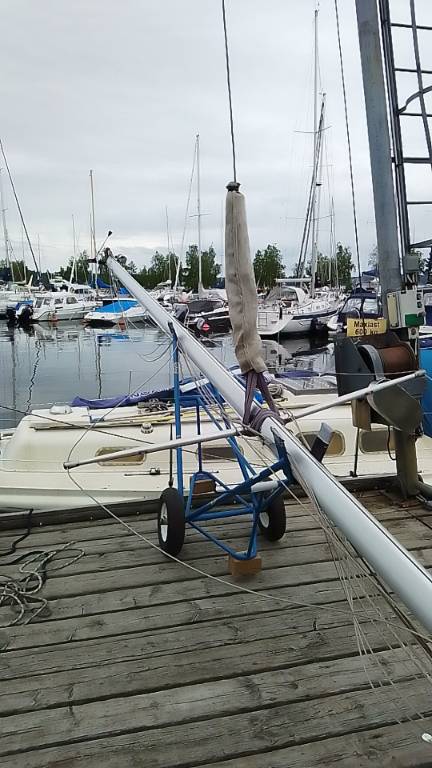
The boat had to be put into the water. The mast installed. The sails set up. Some pipes replaced. New oil. New diesel.
The boat was ready for its new life. A new Hästekasen adventure had started.
The boat
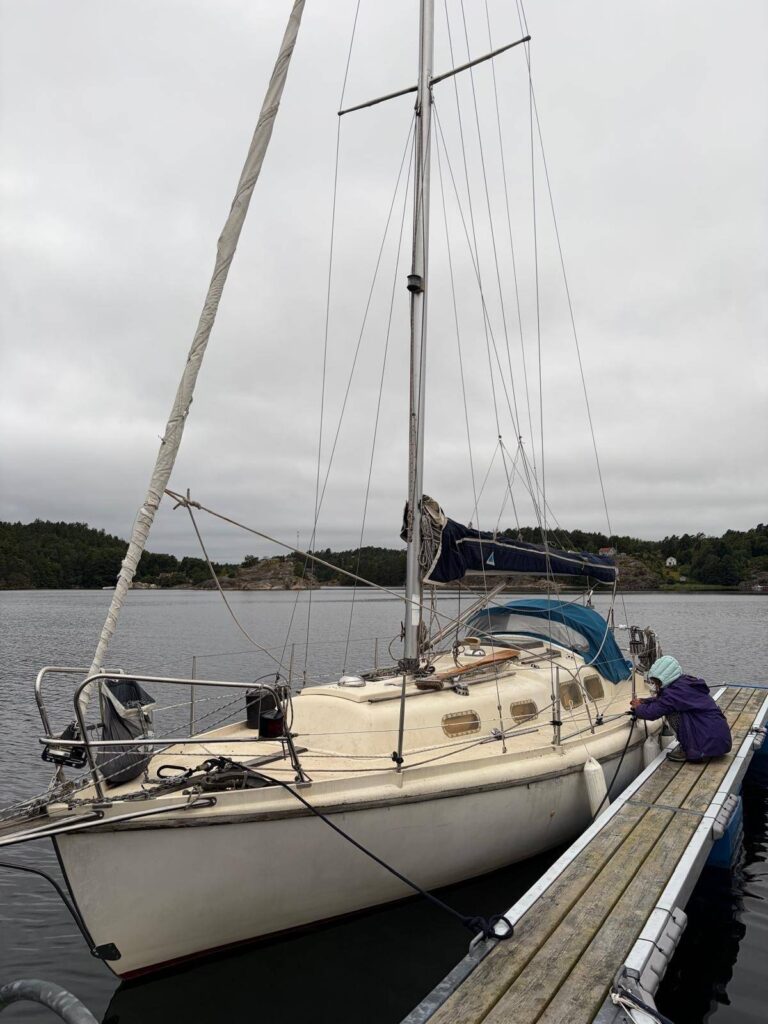
An Allegro.
27 ft (8.2 metres) long. Built in Sweden during the 1970s – an old-school Scandinavian cruising design. Almost three tonnes of fibreglass, ballast and machinery. A long keel for stability and a protected rudder for offshore sailing. An inboard Volvo Penta diesel engine for when the wind disappears. A compact but complete interior with five berths, a kitchen, a toilet.
Built to be steady.
The adventure
THE ROUTE
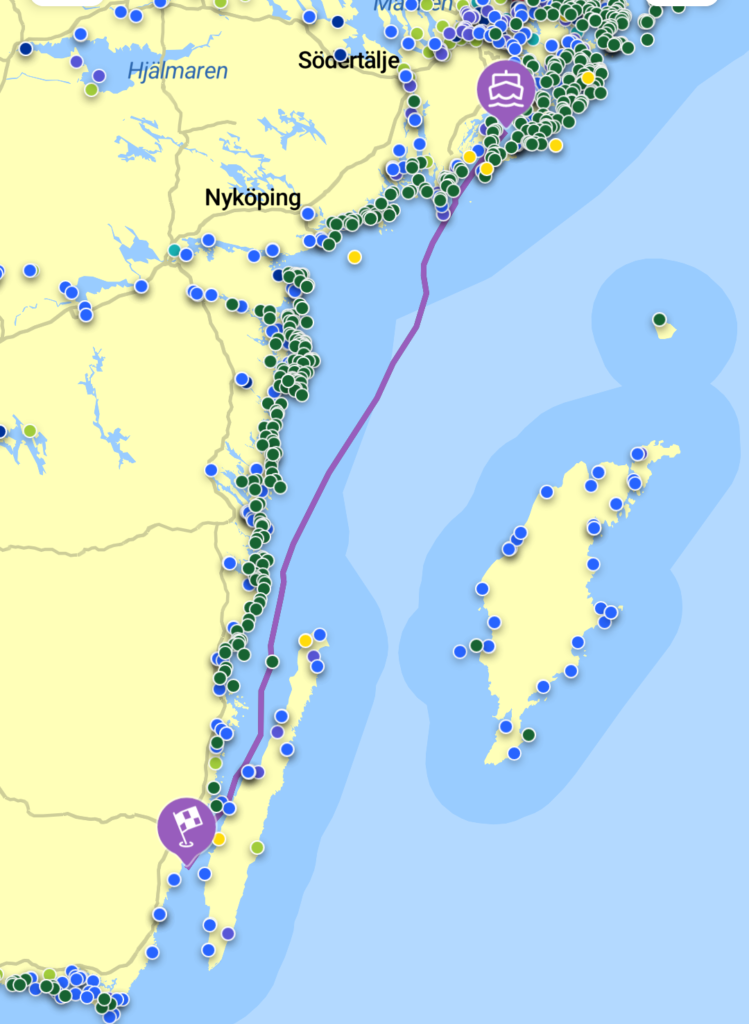
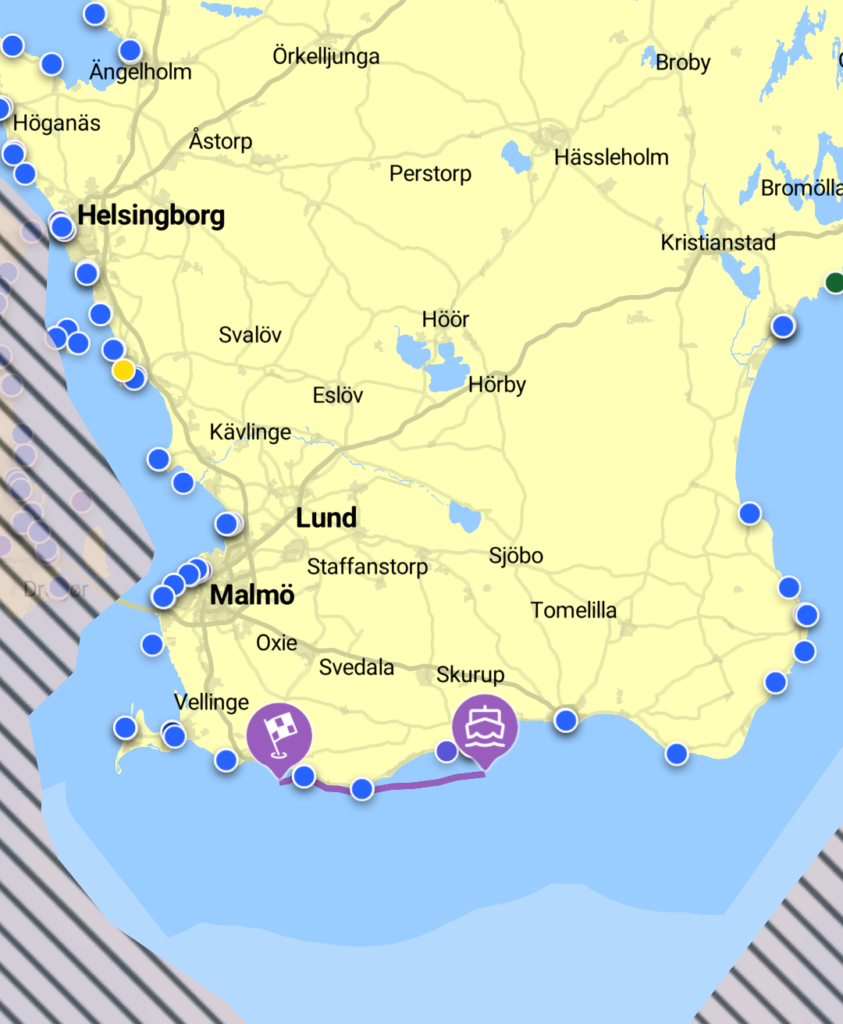
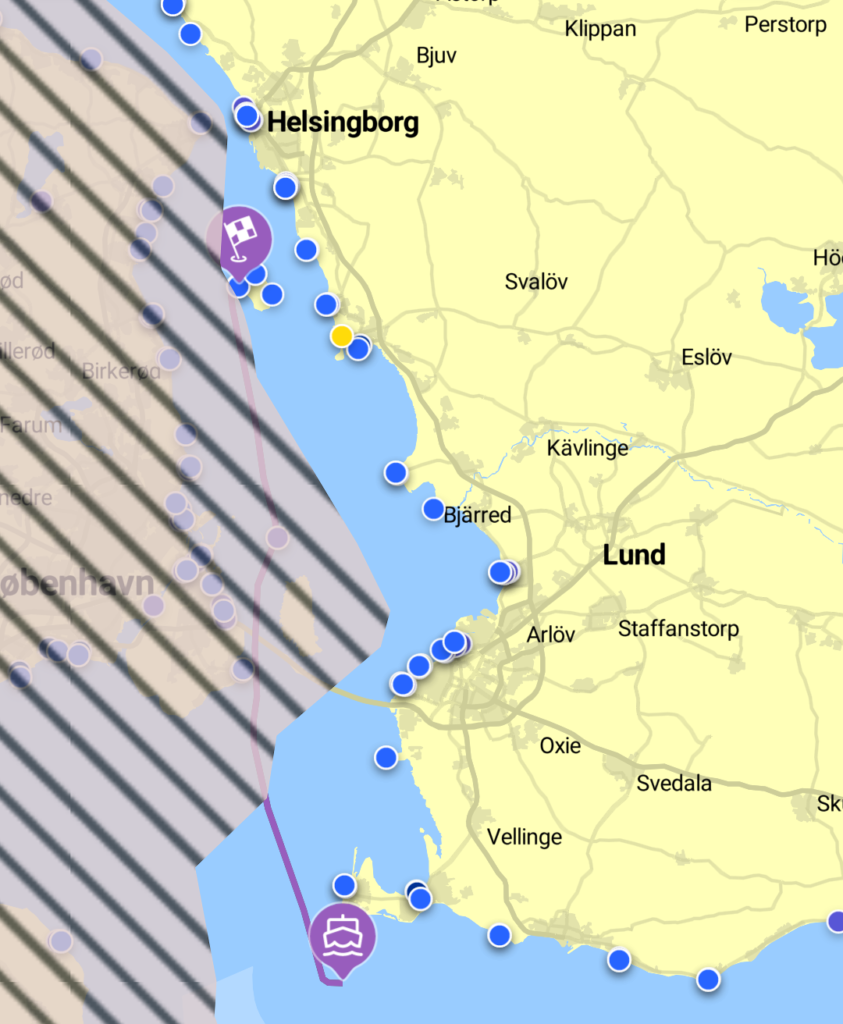
About 400 nautical miles. Around the southern tip of Sweden. 8 days.
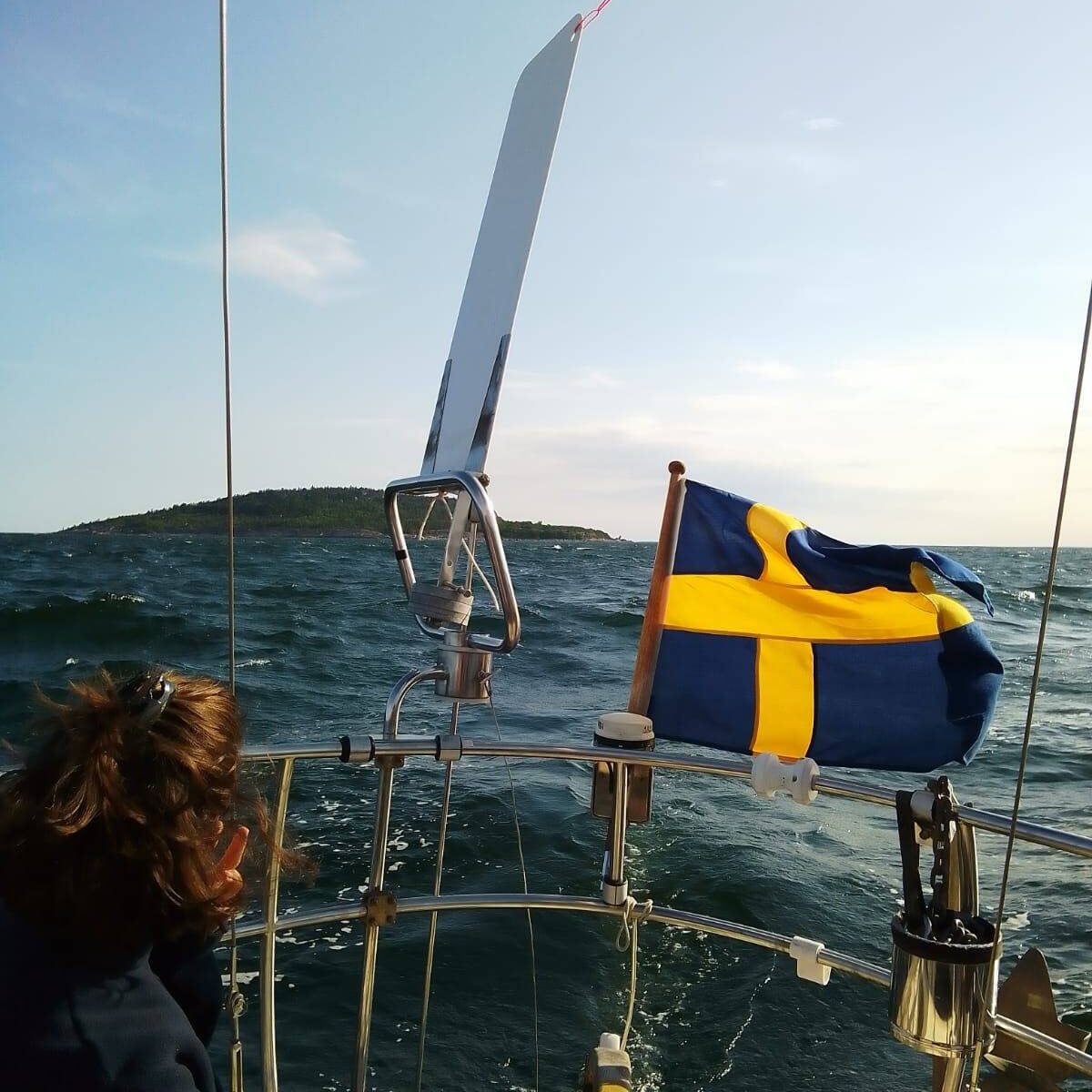
Leaving the Stockholm archipelago, then heading out in the Baltic Sea. Seeking the protection of Öland, passing by Kalmar. From Karlskrona, the seemingly endless Hanö Bay – the great bay between Blekinge and Skåne – before following the coast south. This part gave way to Sweden’s Riviera – long beaches, dunes and small seaside towns, from Ystad to Trelleborg. Passing west of Saltholm between Copenhagen and Malmö, then heading north towards Helsingborg. Gothenburg, then a stop on Käringön, and finally Koljöfjorden – reached in a gale. Home.
Winds came from all directions over those five days. Even moments without a single wrinkle on the surface of the sea.
Fortunately, the engine could run for longer than the 20 minutes expected before overheating. Apart from a seawater leak that meant frequent use of the bilge pump, it turned out to be a functional engine after all.
THE CREW
With only two people on board and a schedule to meet, the trip was a challenge.
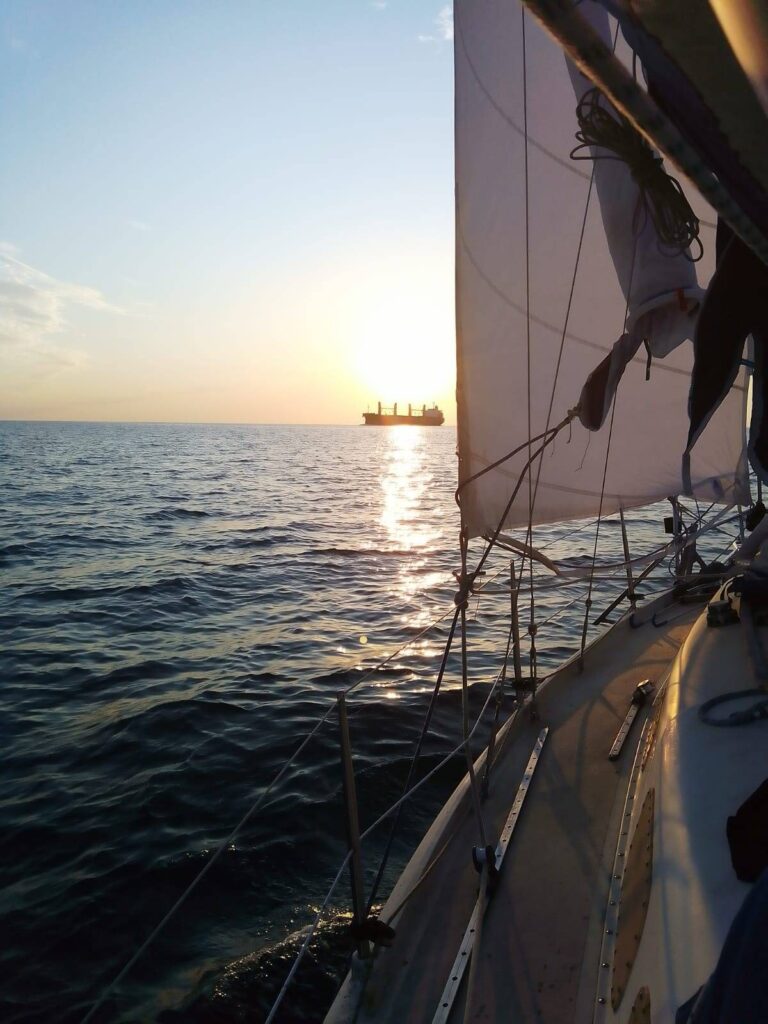
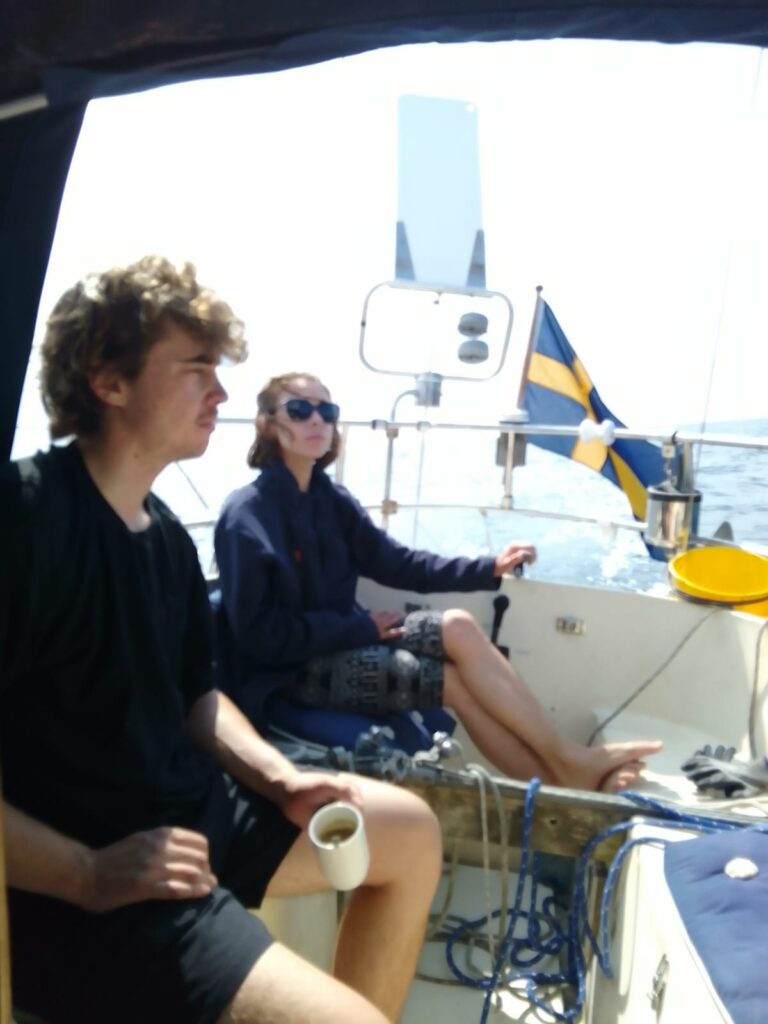
To keep up the pace, night watches had to be taken. Solitude with the stars and the wind, with cargo ships to avoid. The autopilot was used for naps and necessary repairs. And a few hours here and there, anchored near an island, allowed some sleep.
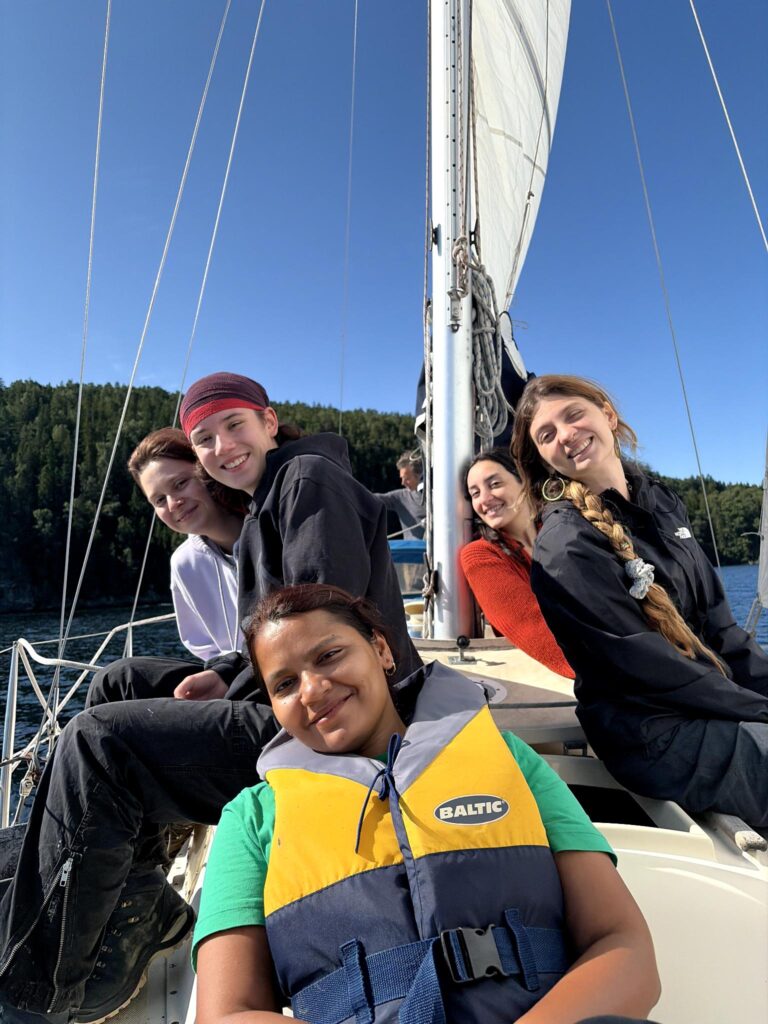
After Helsingborg, a third crew member, a former volunteer from Hästekasen, joined the adventure and became the official photographer of the trip.
LIFE ON BOARD
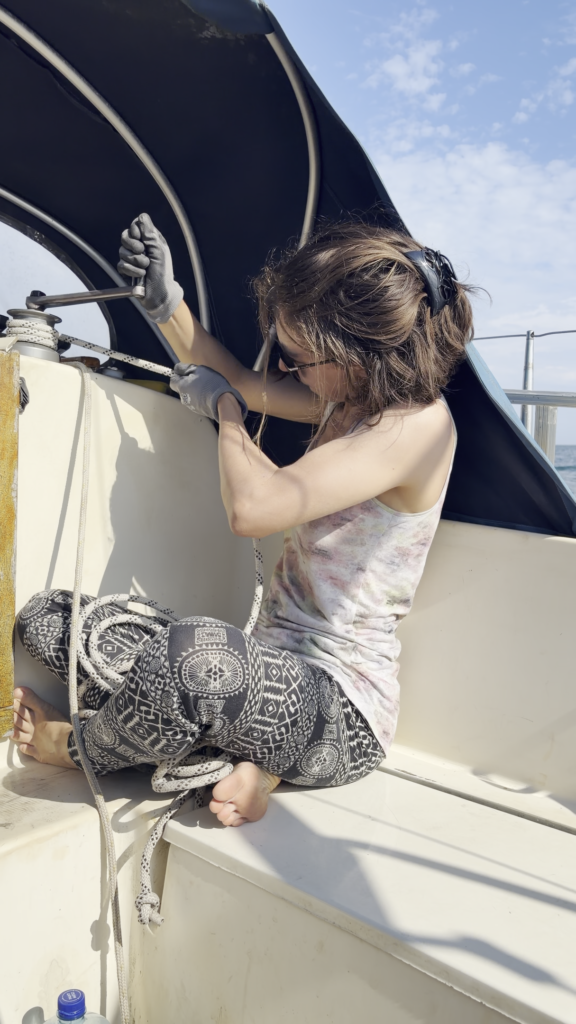
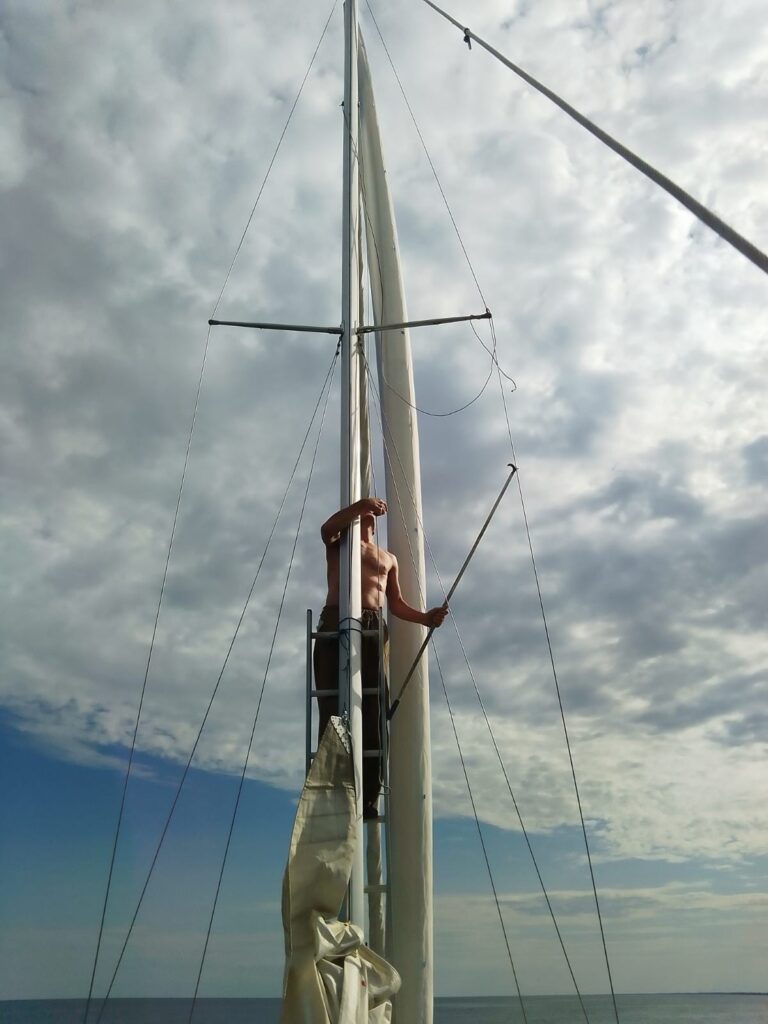
As always on a sailing trip: expect some problems to occur. The toilet tank had become blocked during the years when the boat was not used. A rope had become caught in the stays of the mast. These are only two examples of problems that required some work during the calmest moments.
The calm sailing moments were also used to make life on the boat more comfortable.
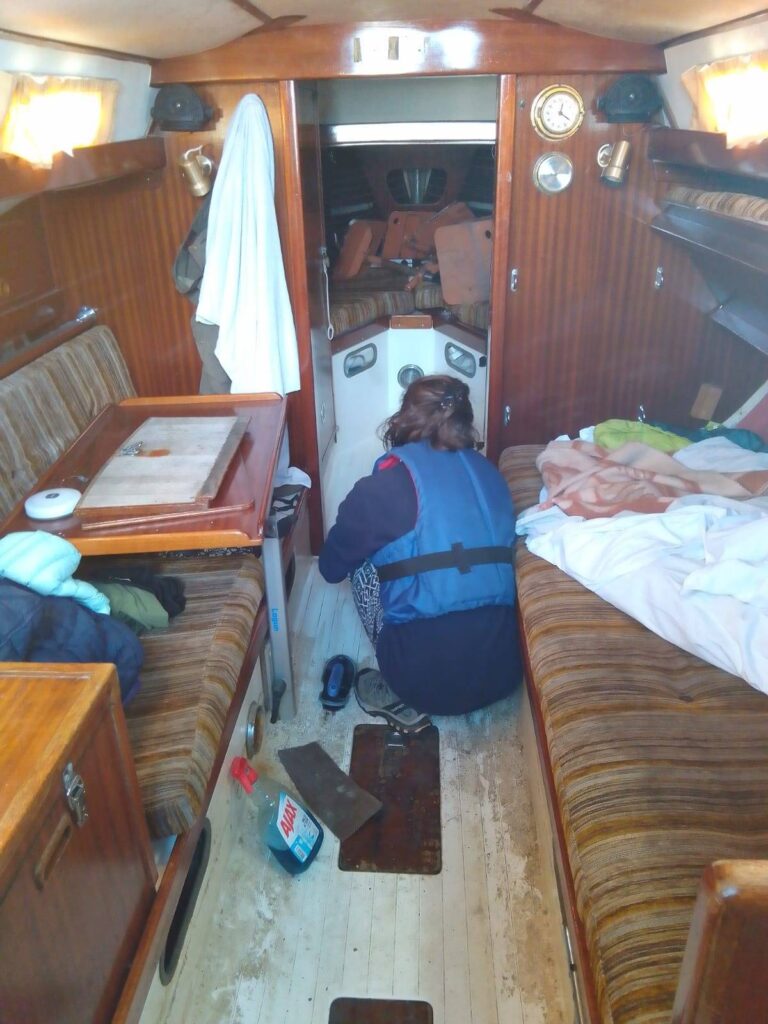
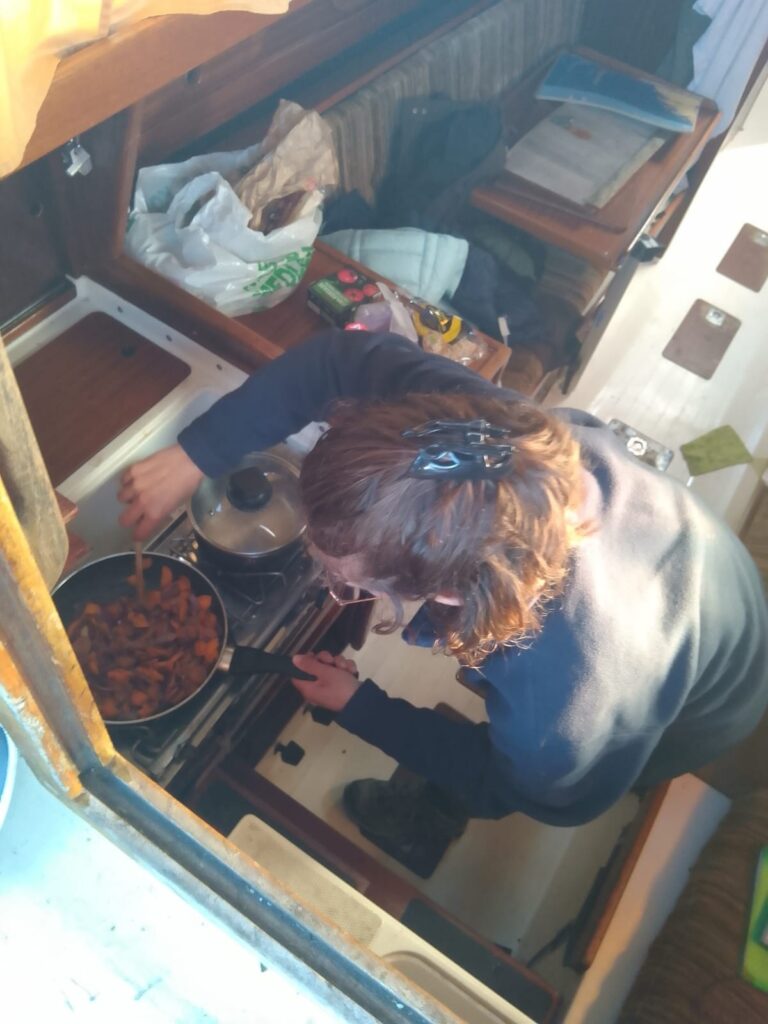
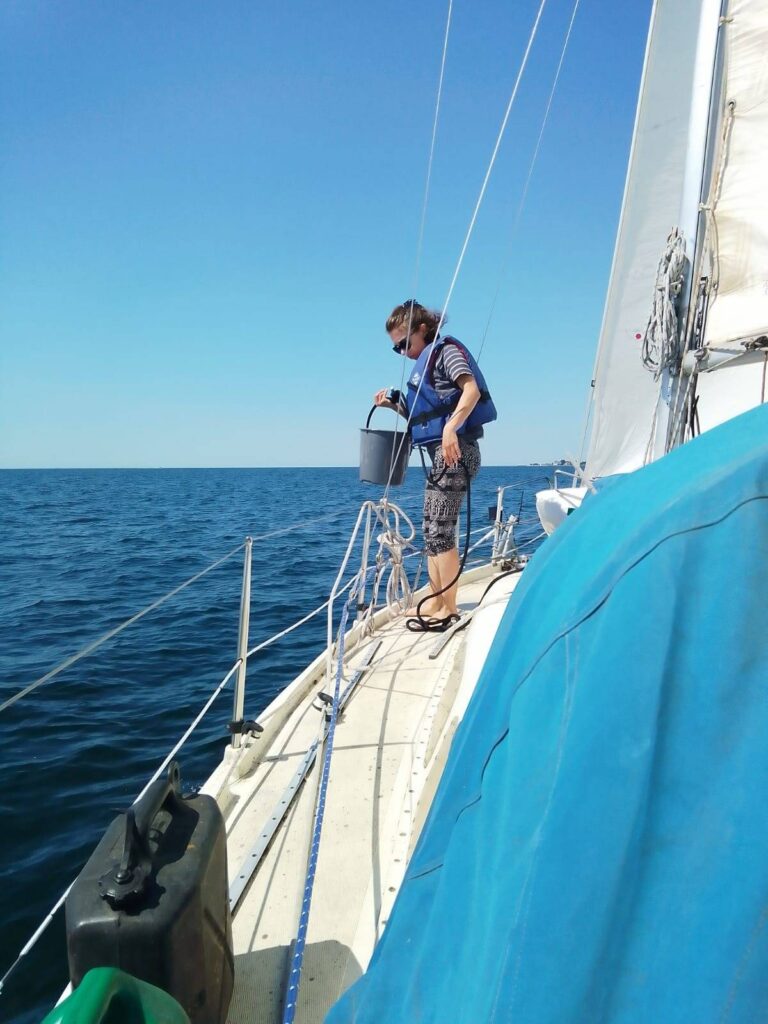
Scraping the mold from the floor below deck. Cleaning the deck. Cooking good food. Over the days, the Allegro 27 became a cozy home.
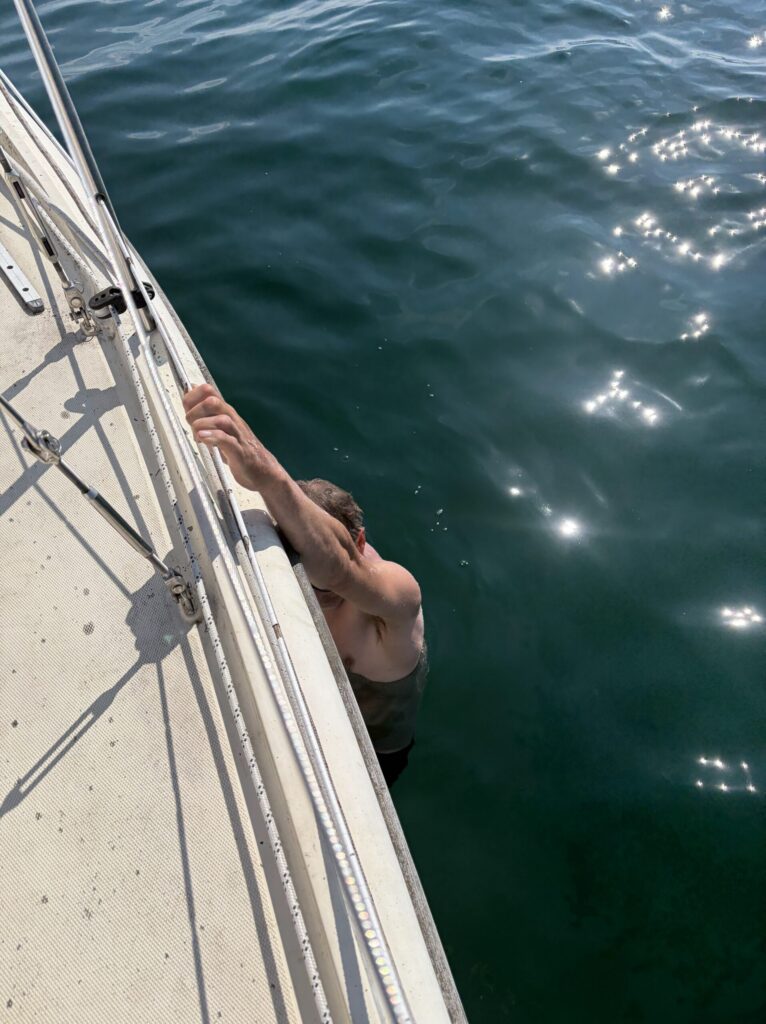
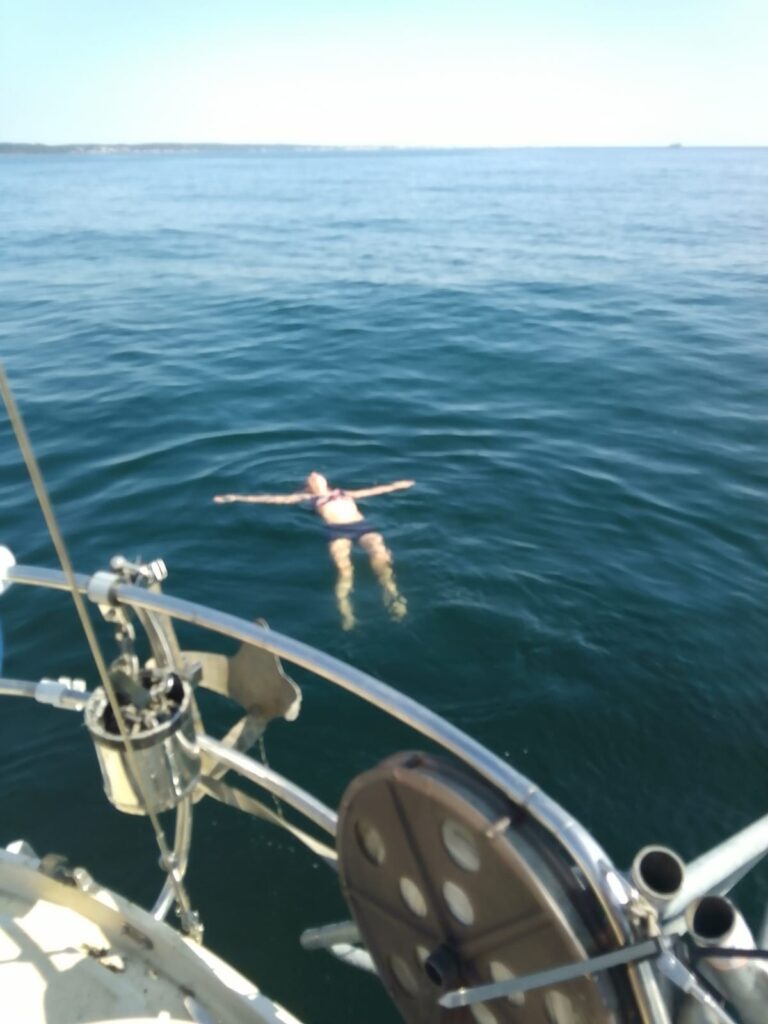
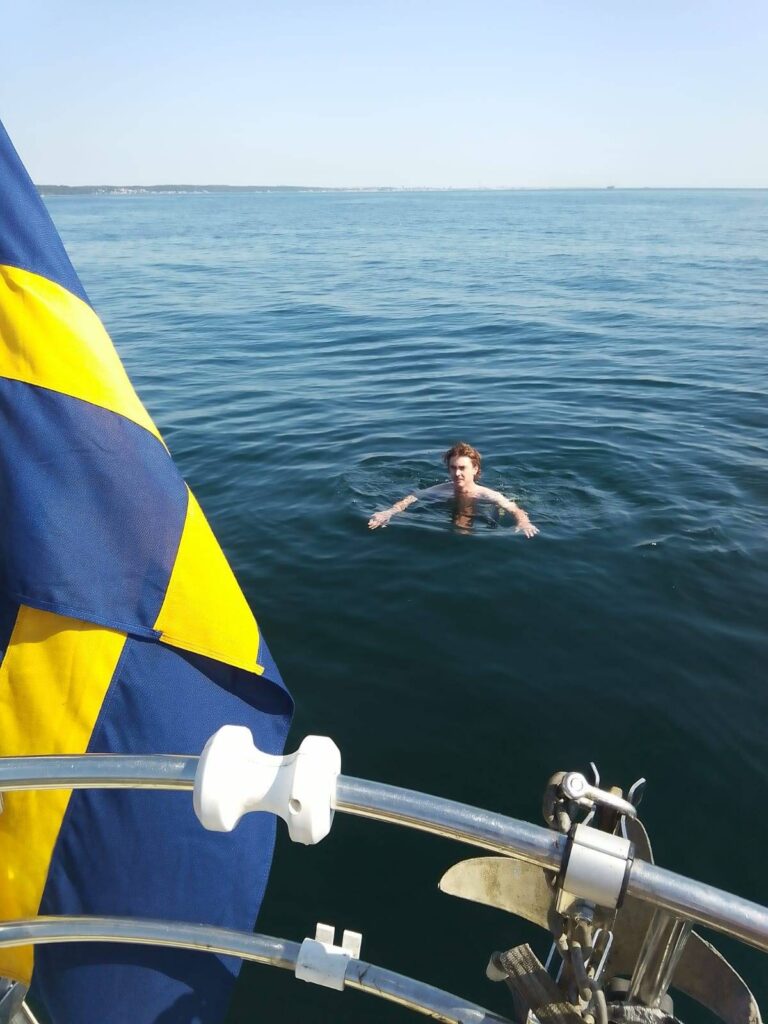
And there was also room for social moments and enjoyment of the beautiful weather. The crew tried the ladder at the stern of the boat and took a few swims in the cold sea.
A new life
After this journey, the Allegro is safely docked in the harbour, in the good care of Hästekasen members.
It is used by the association as a training boat, while also offering beautiful nature experiences to volunteers or visitors who wish to visit the west coast archipelago and its wonders.
It was given away.
It was given a new life.
And with a few more repairs, who knows where this Allegro 27 will sail next?
Epilogue
During the 1970s, many capable sailboats were built in Sweden. Now they’re starting to show their age, with worn-out sails and engines that aren’t running as well. But the hulls and rigs are still in good condition. Many are sold cheaply, sometimes even for free.
Hästekasen specialises in saving some of them. We have already saved three so far. If you’re interested, please get in touch.
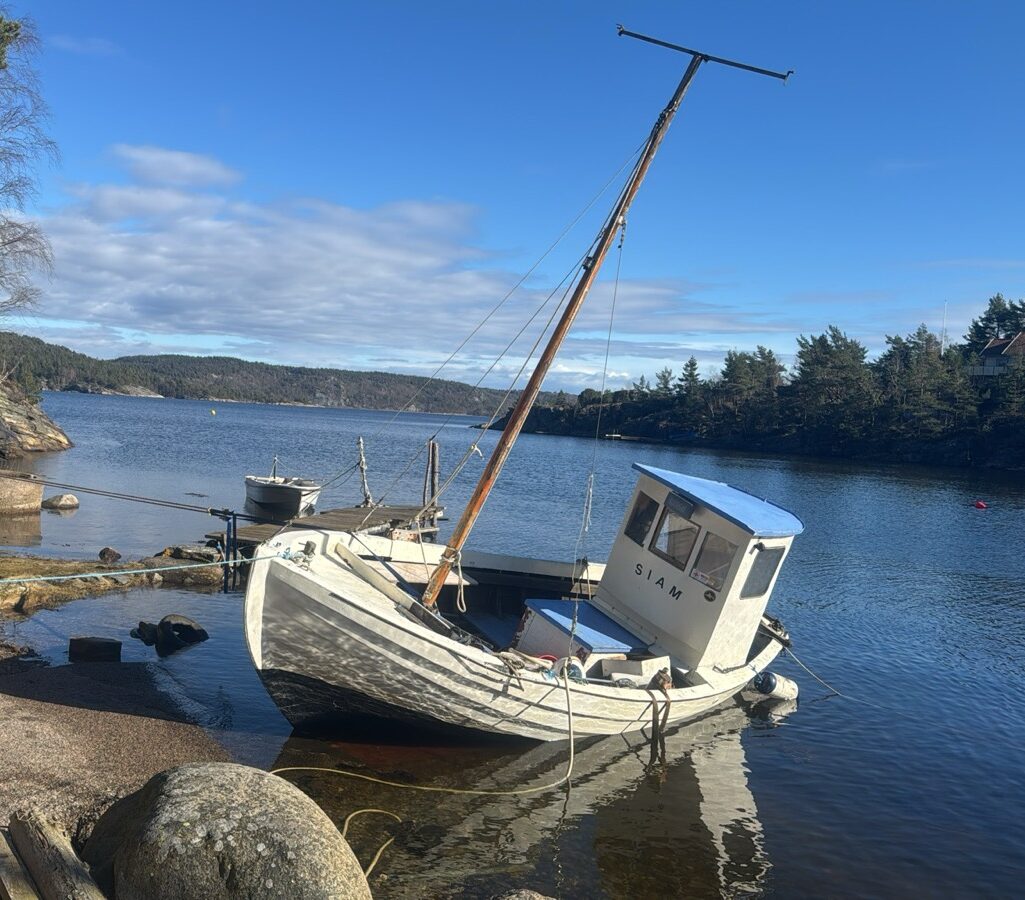
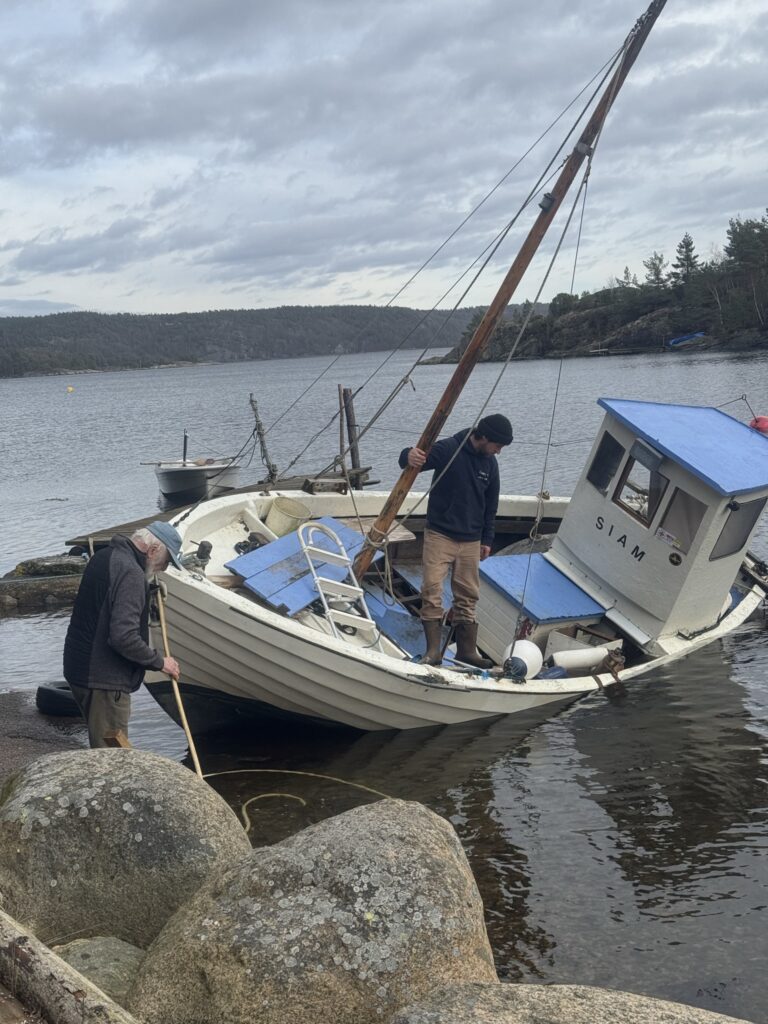
Our fishing boat Siam acquired last summer went through some hardships this winter.
Our fishing boat sinking
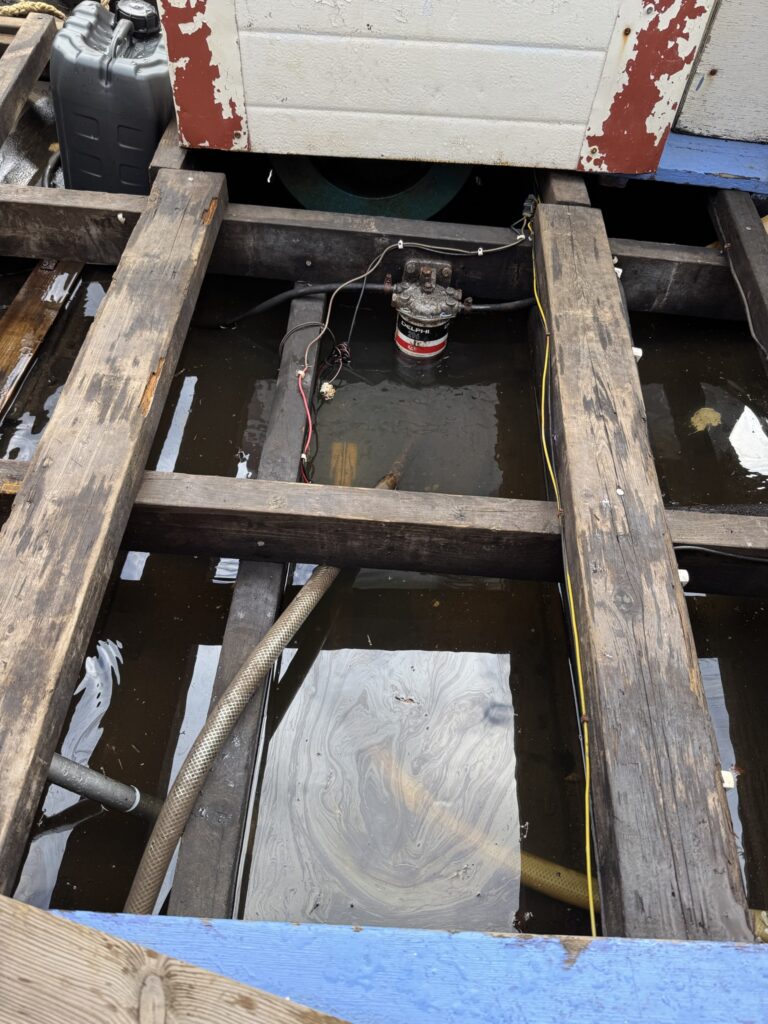
With a hole in the hull, it was close to sinking several times. But thanks to the interventions of Martijn, Sebastian and Agne, Siam was saved.
Equipped with a brand new water pump, connected to a battery charging with a solar pannel installed for the occasion, it now remains dry. Some freediving and dry work are planned this summer to fix the hole once and for all.
But there was still a big problem to solve.
The engine problem
The Volvo Penta diesel engine that had been under water was not functionning anymore. It would simply not start.
Sebastian bought a new starter motor, and with some work together with Jeanne and Chat GPT, the other causes of the problem were investigated.
The injector chambers were inspected, the injectors themselves got tested in Gothenburg, and it turn out that it was the injection pump that stopped the fuel from being delivered.
With some moves that were sometimes random, we finally managed to find a way to start the engine.
Siam back to normal
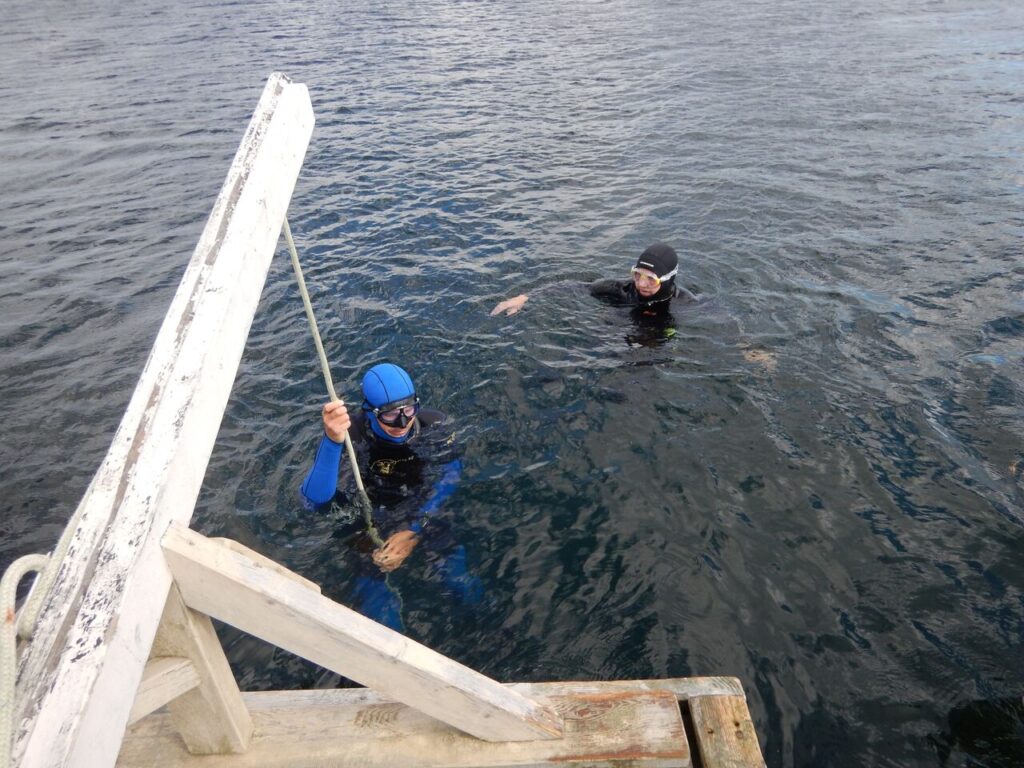
We were rewarded by hosting the first freediving course of the season, as well as a boat excursion with some Hästekasen residents.
A freediving happening featuring many underwater activities.
Date
Starts Saturday August 1st Ends around 4 PM Sunday August 2nd
FREEDIVING HAPPENING CONTENT
Freediving flea market, excursions, depth diving (up to 35 meters), participation in games competitions, test equipment, yoga, sauna, bonfire, film, sleeping place (bring sleeping bag).
Game competitions
Guess-your-depth
Breath holding – Magic 3
CNF Noseclip only
VWT
Depth relay
Team breath holding
Underwater treasure hunt
Other
Booking
Indicate your personal best in depth diving with fins. Also indicate your 2025 personal best, if it is different. Indicate your personal best in static breath holding. Indicate if you have a dive partner with you.
70 € Bank Giro: 5609-0384 STATE name and “Jippo26”
Equipment/suit can be rented: 30€
Bring training clothes and bed linen. Soft clothes for stretching and hat and jacket for boat excursion.
You can also come here and camp in your own tent/van, water and outhouse are available.
Bring your own food for the grill or buy food from us 20€ per day.
Possible schedule
(all activities are weather dependent)
SATURDAY
11.00 Own warm-up in pairs
12.00 Breath holding – Magic 3 Everyone starts simultaneously in static breath holding, the one who ends their breath hold closest to 3 minutes…wins.
12.15Own diving in pairs. Lines at 10, 20, 30 meters 13.00 Guess-your-depth On an unmarked depth line you shall swim down to what you think is 15 meters. Do not touch the line. The one who is closest…wins. May be repeated two times.
14.00 Depth relay in teams (FSE makes the teams) Teams of three. 3×15 meters. Swim or pull yourself down to 15 meters and up again and switch to the next participant through hand clap above the surface. May be repeated two times.
15.00 Sled riding Stand without fins on a bottom weight and be lowered down, release when you want, pull yourself up. Not competition. One chance.
15.00 Underwater treasure hunt in pairs. Find things at different depths on the bottom. 3-20 meters. Area 100×20 meters. Stones in colors of gold 5 points, silver 3 points, white 1 point.
17.00 Diving ends
18.00 Sauna
20.00 Dinner, bonfire in the Tavern. Calculation of score standings.
SUNDAY
9.00 Yoga
10.00 Breakfast in the tavern.
11.00 Own warm-up in pairs.
11.00 Underwater treasure hunt in pairs. Find things at different depths on the bottom. 3-20 meters. Area 100×20 meters. Stones in colors of gold 5 points, silver 3 points, white 1 point.
12.00 Team breath holding In teams of three hold your breath as long as you can in relay. Longest total time wins. Next participant must be under the surface before the next diver comes up.
12.30 Depth relay in teams (FSE makes the teams) Teams of three. 3×15 meters. Swim, or pull yourself down to 15 meters and up again and switch to the next participant through hand clap above the surface. May be repeated two times.
13.00 CNF Noseclip only As deep as you can with only nose clip and swimsuit. No mask, no suit. This category has a special prize.
13.00 Sled riding Stand without fins on a bottom weight and be lowered down, release when you want, pull yourself up. Not competition. One chance.
13.00 Underwater treasure hunt in pairs. Find things at different depths on the bottom. 3-20 meters. Area 100×20 meters. Stones in colors of gold 5 points, silver 3 points, white 1 point.
15.00 Diving ends
16.00 Meeting at the farm, prize ceremony. All performances are counted together (approximately 12 competition efforts). Your placements in each competition.
Hastekasen Farm and adventure center is on occasion renting the sailing yacht Bon Aventura to use as an educational platform for Adventure learning and leadership training. How can an adventurous situation enhance learning different competences? Everything from the obvious; boatmanship, sailing, navigation, mechanic and electrical skills. But also; team building, creativity, organizational skills, leadership. At times done under stress full situations that have real risks and consequences.
While living onboard there will also be development in communication, cultural skills, civic competence. Since the project is “open” there will be lots of documentation and story telling (inspiring others). And all the time – personal development; encouraging; curiosity, boldness, self awareness, entrepreneurship.
The EU project is called Key action-2 partnership. It has four partner NGOs and the purpose is to educate leaders/youth workers in the method adventure learning, and in the process of travel/adventure explore and strengthen European identity.
The funding is partly for non-formal learning activities (Sometimes on board a rented boat, sometimes more forest oriented)
The rented boat is s/y Bon Aventura that will take shorter and longer educational trips with participants.
The aim is to meet other NGOs and make lots of inspirational / educational videos that talk about; adventure and learning and to some extent European identity.
2023 – Sept – Preparatory sail and inventory – done 2023 – Sept – Big walk and Alarm adventure learning exercise – Done 2023 – Oct – TPM – Leadership coordinators meeting and sailing – Done
2024 – April – Experiential adventure sail #1 – Done 2024 – April – Big walk adventure learning exercise – Done 2024 – April – Alarm adventure learning exercise – Done
2024 – May – Experiential adventure sail #2- Done 2024 – May – Big walk adventure learning exercise – Done 2024 – May – Alarm adventure learning exercise – Done 2024 – May – Sail training – Done 2024 – May – Experiential adventure sail #3 – Done 2024 – May – Experiential adventure sail #4 – Done
2024 – June – Sail training – Done 2024 – June – Big walk and Alarm adventure learning exercise – Done 2024 – June TPM meeting and workshops and sail – Done
2024 – July – Experiential adventure sail #5 – Done 2024 – July – Big walk adventure learning exercise – Done 2024 – July – Gimle edu larp adventure 2024 – July – Alarm adventure learning exercise – Done
2024 – August – LTT (a,b,c) – workshop and long sail – Done 2024 – August – Dissemination, study visit trip – Done
How can an adventurous situation enhance learning different competences? Everything from the obvious; boatmanship, sailing, navigation, mechanic and electrical skills. But also; team building, creativity, organizational skills, leadership. At times done under stress full situations that have real risks and consequences.
While living onboard there will also be development in communication, cultural skills, civic competence. Since the project is “open” there will be lots of documentation and story telling (inspiring others). And all the time – personal development; encouraging; curiosity, boldness, self awareness, entrepreneurship…
The adventure learning method can off course be applied in many situations that are signified by: real live situations, with aspects of uncertainty, risk-reward, physical challenges, positive stress, accountability for personal actions, and often in nature. It is often signified by demanding full attention from the participant. It could be hiking in forest or mountain, canoeing, bicycling, different adventure sports – and on top of that adding situations with tuition/coaching/workshops. And situations of trial and error where applicable.
It implies not only learning practical specific skills, but a more holistic learning situation that also encompasses the competence aspect of “attitude”.
Sailing may seam like a inaccessible activity for most, but Sweden is known for its vast archipelagos that is accessible for anyone with a boat, and small boats can be very cheap in Sweden (if knowing where to look), if being able to overcome lack of equipment with skill.
Christmas full moon 24th December 2023. Darkest month of the year.
More people have summited Mount Everest, than climbed Kebnekaise during midwinter (one story “Kilimanjaro was a walk in the park compared to this” it was end of March and they failed) (webcamera)
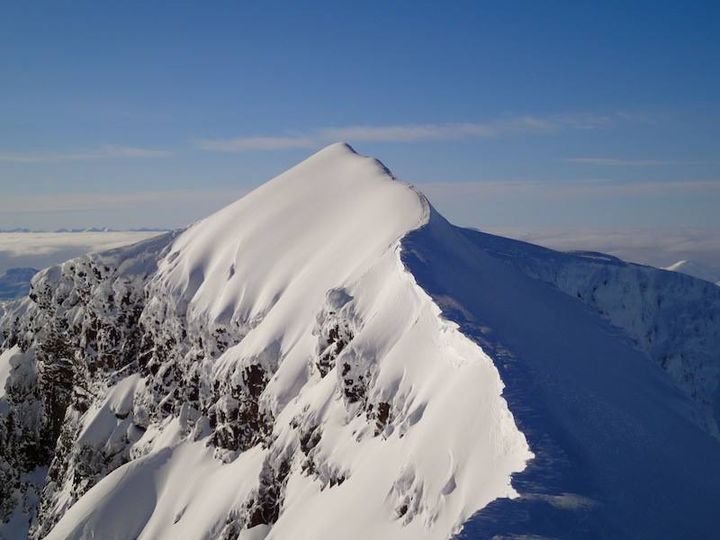
Kebnekaise is Swedens highest mountain. It is only 2100 meters high, but its still 1600 meter to ascend and it is above the arctic circle. Summertime it is just a hard trek with hostels at the base of the mountain. Wintertime it is a real challenge. Dark (5 hrs light a day), cold as fuck and possible storms, and no hostels open. 2016 I failed reaching the top, (and I am a person that has climbed Everest to 7000meters). Not even Swedish mountain military commandos train here during this month, they wait until march to play around here. So this means one has to be trained and prepared, and with the right gear.
We are inviting team members… the more the merrier. But you must abide the rules, do the training and bring the ´gear.
I suggest only aiming for the south top (its a few meters lower). North top is bloody dangerous, especially during winter.
Schedule
Two schedules (alternative schedule to reach peak at shortest night and slower pace)
17th Weather check + start travelling to HFA (14th) 18th team assembles at Hastekasen (15th) 20th leave Hastekasen farm — (17th) (20th camp out, 21st booked hostel) 22rd Park Cars at Nikaluokta (camp out or hostel (500skr)) — (19th) 23rd 05.00 start ski to base camp (K station: closed?) — (20th) Peak at: 2023 December 24th at the fullmoon — (22nd) (or one day later, we may need to make an ABC camp) 25th camp below — 23rd 26th reach cars – mega sauna, dinner, bed at Hotel (800-1000skr) — (24th) 29th return to Hastekasen — (28th) + 3 extra days if weather goes bad.
Weathercancel: 18th December decision (15th) – If rain = cancel – If colder than -20 = cancel or delay – If more than 13 m/s = cancel or delay
Alternative activity if weather cancel?
Route
Hastekasen – Nikaluokta 1600km (to bring the Van will cost about 9000skr) (4 maybe 5 people = 2500 skr travel costs) Nikaluokta – Base camp 20km skies Summit attempt + 17km and 1600 height meter (Strong people create ski tracks, carry shared gear / sled and set up first tents, boil hot water)
First stage
Skiing 20 km in one day with heavy gear in deep snow, darkness, maybe in bad weather is – tough. We should seek the scooter trails, head for the lake and ski on the lake. We may want to use the full moon whenever we can. Camp with tents in lee of the station. Dump gear here. Second stage: Start of with skis, that may only work a few 100 meters. With special skis one may be able to go higher. Switch to snow shoes. Walking 1600 height meter in heavy snow in darkness is probably impossible to do in one day. Lets bivouac 2/3 up. Dump more gear and do the last stage whenever weather and moon says yes. Third stage: Summit attempt. Trick is not to get lost and fall down the ravine (east side), visibility can be low. We may have to walk very slow. Weather can change in a few hours. We must make it back to the bivouac. Any attempts at North top must be done alpine style, crampons, ice pick e t c in good conditions. Fourth stage: going down, can be done pretty fast, stay together – this is when people get injured and die. We may have strength to just short rest at base camp at the station and then ski non-stop to Ninaluokta and a hot shower/dinner.
Level of training
video Many compare the effort of the climb SUMMERTIME as running a marathon! If you join, make sure you can do the following: 10k under 1hr 4.5 hrs walk with 20 kilo back pack (in the same boots as intended) Treadmill 15% elevation, 4km/h for 1h Ski for 4h (also added training with roller skies) Use the walkie treadmill in the gym to train ski movement (use your boots) Walk 30 km with 15kg backpack (in the same boots as intended) Everyone must be able to memorize the route without map
Gear
Cars must have winter tires (dubb) Goose feather clothing + goggles Skies & snow shoes and crampons (Randonnée ?) (Ice axe ?) (transceivers for avalanche ?) – 18 sleeping bag Map, compass, super headlamp, one carbine hook Fully charged mobile with powerbank Personal kitchen + 4 kilo food + snacks e t c (HFA has: tents, maybe gas kitchens, compass, whistles, sled, 5 seater car, walkie talkies some sleepingbags (but not that warm).
Avalanche signs:
Heavy snowfall
Sudden warmer weather / rain
Recent avalanches
Sounds of moving snow masses
Traveling on leeward slopes is dangerous, especially if it’s a north/northeast-facing slope.
1 in 4 dies in avalanches
Equipment:
Avalanche probe (like a pole)
Shared gear
Sled Two snow shovels 30 meter rope with “puller” Walkie talkies First aid bag
Rules
– Each person turns when ever they want (live to fight another day). – Know your limits, don’t be macho and destroy he expedition. – Be ready to turn even if its just a 100 meters left. – See the weather cancel rules. – No body goes alone. – We may split up in two man teams. – We can change teams along the way, depending on ambition. – If some one is injured we may split the team, some continue, some return. – If some one dies we abort.
Facts
1800 m a small hut (only protects for wind) 2040 m a small hut (only protects for wind) The western route takes you to the plateau and a glacier, here it gets dangerous until the south top, from there to the north top is VERY dangerous. Moon rises around 3PM and is up all night until 9.00 in the morning. Fullmoon is at 27th.
Team
Sebastian Max Rami ? Axel ? Peter ? Mati ? Daniel ?
Questions
Will there be mobile connection? Probably not always. How accurate will GPS be? Are we ready to build a bivouac half way up and sit there and wait out a possible storm? For how many days? Which road up? Coast or inland? When does the moon rise?
Transceiver
Avalanche backpack
Memorize this, but remember, its summer.Already at point A, you might have to ditch your skis if you don’t have some kind of climbing skins. If you need to stop before the top, point C might be suitable, just before the steepest ascent begins.
Hastekasen farm Association (HFA) study visit in Ukraine, winter 2023
Sweden-Ukraine-Sweden 5200 kilometers. 18 days. 10 days in Ukraine. 14 places visited. Uzhhorod, Kolomyia, Chernivtsi, Vinnytsya, Kropyvnytskyi, Cherkasy, Bila Tserkva, Rivne. Also: Tepla Gora, Kosiv, Charivne, Zeleni Kruchi, Emilianivka. Sebastian and Jakob (HFA members) in the car.
BACKGROUND
I personally got very upset when russia invaded Ukraine a third time. I don´t really know why. Maybe because I felt it was a real breach of 70 years of peace in Europe (apart from civil war in Jugoslavia). Maybe because it is fairly close to my country. Maybe because I know some Ukrainians. Or just the sheer cynical act of killing so many people just for what… building an empire… geopolitical reasons. HFA owns a van financed by Erasmus (EU). We are suppose to do youth work with it, and spread the idea of Erasmus. I am also interested in eco-communities and have heard about a few in Ukraine. Why not do three things at the same time: bring down some aid, and visit some projects. The third reason is about me being bored and in need of a adventurous vacation. I am also interested in politics and wanted to check out what kind of country Ukraine is, that wants to join EU and even Nato.
THE WAR
We passed many road blocks, there was a night curfew and “bomb sirens” in some of the cities visited… may sound dramatic for those that are not at war. But compared to the war on the frontline… these were small issues. Roadblocks and curfew just made us feel safer. It has a limiting affect on possible crime, I suspect. One estimates that 7000 civilians have died so far in the war (maybe not counting Maripol), the amount of civilians killed by rockets in the west and middle of Ukraine and outside of Kyiv was when this was written about 200. That is 200 during nearly a year in a huge country in an area of maybe 20 million people. My estimation is that road traffic and covid are more deadly that rockets in the areas we were travelling.
ABOUT UKRAINE
What I realized. Ukraine is huge. Lots of people live in Ukraine. It is a country with modern cities and very simple villages. Not as poor as expected. While media was reporting on war, suffering and victims… I was travelling in a modern country where there was lots of (for us, cheap) fuel, ATM´s working, hotels and restaurants, credit cards accepted. Roads between big cities was good, but much worse on the country side. Yes there were many dark cities and electricity cuts came and went. But since I am a person that has lived off-grid and partly was brought up in a country with regular power cuts – I don´t take electricity for granted. And the association HFA does train youth to be more independent from modern luxuries. I am aware of that behind the scenes Ukraine’s economy is in collapse, unemployment and inflation. And some millions of internally displaced people. What keeps this country going is support from the west and hard working Ukrainians.
THE TRIP
We got organizational support from GEN-Ukraine (Olha Simon) and Youth centers Ukraine (Dmytro)
The journey first went via the ferry to Poland and down to Krakow where the association has partners. Further to Slovakia which I wanted to see as I had never been there, and closer to the Carpathian Mountains which I also wanted to see. A trip like this naturally depends on a working car. This was a Renault Master Van that had only done 5000 km, but had many problems before. I filled the car with “car equipment” and equipment for very cold weather. In addition, all gifts to Ukraine. The border control was as expected frustrating – more or less non-existent English by the staff – even on the Slovakian side which is an external EU border! We were treated as “goods”. They wanted a list of everything and a receiver and would like stamps on everything. Took time. Now we know what is required.
In the city of Uzhorod, at the community center in an old Soviet movie theater, we were greeted by teenagers singing in our honor. Then pizza and conversation via an interpreter. Young people spoke more English than the older people. In the evening we went out into the forest to a hermit who lived in an imaginative mud house he built himself (our association deals with similar things). Next day on to the mountains. Climate change is increasingly playing tricks with the weather and the journey began with mild weather and sprouting grass (January) over the Carpathian Mountains. We visited another youth center in Kolomyia and had dinner with two volunteers and stayed overnight with one of them. The next day up in the beautiful mountains where we spent the night in an “eco-village” (Tepla Gora) where we met the first internally displaced persons. Good conversations by the fire and overnight stay. We left some stuff here. We had coffee with a young guy who was an NGO volunteer in various eco-village initiatives. Heard our first “air alarm”. “When in Rome do as the Romans do” – which meant: we did nothing. On to visits to youth centers in Chernivtsi, Vinnytsya, Kropyvnytskyi and Cherkasy on the Dnipro river (Sorry for all misspelled city names). We were very well looked after by “the locals”. And got full descriptions of their activities. One night we had dinner at a simple guesthouse and drank a glass of wine and rented a room. Cost SEK 35 euro in total, lovely country to tourist in for westerners.
THE AID SITUATION
We had misunderstood a lot about the situation in Ukraine. The situation can change fast in Ukraine. And the media picture is not always accurate (much focus on war and suffering). On the contrary we found western and middle Ukraine very functioning. A modern country. Until now, no one really needed the winter clothes we mostly carried with us. We had asked private individuals in Sweden to give us warm clothes and other things (see list of donors at the end). It’s not that the Ukrainians don’t have winter clothes – they had winter even before the war. What Ukraine needs may shift. HFA could not afford to buy electricity generators or material that frontline soldiers need. We and some donors had bought things for total of 1000 euros and on top of that second hand things. Most of it was left in places where internal refugees could get access to it. Our 2500 candles was very appreciated, also flashlights and power banks and sanitation items. We soon learned that the meetings themselves were a form of “aid”. People in Ukraine became grateful that we in the West care and that they can talk to us “face to face” and reflect, talk and exchange ideas. To be seen and not forgotten.
THE TRIP #2
The electricity went out from time to time in the cities we visited. We heard “air alarms” three times, but no missiles came to the regions we were in. We turned off from the main roads and drove through simple dark villages. Houses in a row along kilometer-long village streets. High fences and closed gates. Most houses old and worn, and mostly made out of mud, logs and some bricks. Cement tile roof. We left some of our stuff in a village school. On to two eco-villages. Cherivne and Zeleni Kruchi. Well received with beds and home-grown food on the table. Pickled vegetables from the underground cellar and home-baked bread. Good conversations. Came across some internal-refugees in one of the “villages”. Left more stuff here. There are many different cultures in Ukraine. City dwellers are clearly different from country dwellers. Ecovillagers often have little in common with ordinary villagers who sometimes(not always) live in social misery (did someone say “vodka”?). There is also some tension between the Ukrainian and the Russian culture in the country. Being a native Russian was rarely a problem before Russia invaded the first two times – but lately Russian has become a problem (see below).
THE ENEMY
Since I have been studying this war for more than 500 hours and visited Ukraine during war – I have an opinion about this war. I do not like when some media portray it as “Putins war”. This is not putin’s war. This is not russia’s army which is the main opponent. This is the russian people’s war. The war against Ukraine has broad popular support in russia (moscow). If putin disappears, the second most popular leader is Prigozhin, the leader of the ruthless war criminal-terrorist force.
It is difficult to get even the russians who fled the mobilization to distance themselves from the war. The average Russian believes that Russia has the right to dominate its neighboring states. Russia and its people are an empire that takes land with the help of weapons (Afghanistan, Georgia, Chechnya e t c). russia is an active colonizer – displacing 100,000s of people as a method (Under Stalin, under putin – same method). Russians settlers are moved into occupied territories.
Russia attacks with language. Therefore, many Ukrainians have stopped speaking russian and even if their mother tongue is russian, they practice Ukrainian. Libraries clear out Russian books. Moscow takes the presence of russian speakers as a pretext to invade and “protect” a minority. (Just as Germany annexed Sudet, Austria and other German speaking territories.) russia invades with russkiy mir – a russian world of peace and russian culture that comes when they subjugated a neighboring state and made them a vassal state with second class citizens. That is why the Baltic countries quickly joined NATO, they know russia well. (That is why it is a problem that there are many russian speakers in for instance Lithuania). Sidenote: I once wanted to work with an association in Lithuania that was led by russian speakers. I wanted to know their stance on the war. They could not denounce the invasion – they said the situation was “complicated”. I cancelled our cooperation.
The russian population are experts at feeling like victims, but being perpetrators. They think they are defending themselves against NATO attacking them. They do not consider Ukraine to be its own state that has the right to choose its own path. After Russia broke the Minsk agreement, in my opinion there is no point in sticking to it anymore. There are indications that 3 out of 4 russians are now against the war. I am convinced that these russians are against LOOSING the war, or against THEMSELVES taking part in the war. They still would not mind a russian victory.
Yes I acknowledge that this is a proxy war where USA enjoys seeing their age old rival suffer – but it is mostly a war where Ukrainians are fighting for their freedom. Just as Finland fought of the russians some 75 years ago and thus became a prosperous free country within EU.
It will take generations of Ukrainians to forget all the war crimes: the terror against hospitals and electrical installations. The executions of tied up prisoners, the torture, the rapes. The stolen children. And even if 100 years has passed, things like the Holodomor is not forgotten.
The worst that could happen to the Kremlin is that Ukraine develops like its Slavic neighbor Poland (which is booming). Belarussians will take note of that, and in time the Moscow residents will too.
An imperialist russia will always be a threat to its neighboring countries – and Sweden is also a neighboring country that russia has made explicit threats against. As a person driving aid to Ukraine, russia has put a price on my head (I have heard they pay 20.000 dollars for dead or captured aid workers). And if Sweden send Archer (the World’s best artillery system) we are basically at war with russia (according to me). And it will be a long war. And the strongest economy wins (russia is a tiny economy compared to the EU). As long as the EU’s population endures longer than the russians. Unfortunately russians are tougher then western people – they can suffer longer.
russia must learn that it does not pay off to attack in the westward direction. I would prefer that russia is beaten down down to its knees and the russia federation is broken up so the colonized 30+ languages/cultures of the eastern russian federation get autonomy. Hopefully, after the war, the EU can prevent a revanchist Russia. A European democratic Russia would be a good alliance partner for the EU in a future geopolitical landscape. The US will not be around forever. There is every reason to hand out a “carrot” to the people of Russia – “if you seriously “normalize” your country and respect your neighbors, we will cooperate with you”. But as for now I think they are too proud. They think they should be an empire – above the rest of us. Nationalism in its most ugly face.
Until then… russia is paria to me…. and will be until I die most likely.
CRIMEA
… maybe the core of the conflict. Russia could have been sufficed with Crimea if it was not for the fact that Crimea needs the Kherson oblast – it can not function without it. Khrushchev knew this when he transferred Crimea to Ukrainian administration. Crimea itself is neither Ukrainian or russian – it is a multicultural place… or was… before the russians started displacing people. Deep down, West don´t really care who Crimea is controlled by (west did nothing much 2014). Of course it would be in the wests interest if Ukraine owned it, but it is a fact that Crimea is the one oblast where there were most opposition to Ukrainian rule. Many referendums have been held, the one I trust the most was the one being done 1991 before different parties started to meddle in Crimea. About half the Crimean population was positive to Ukrainian rule. That may not mean that the other 50% wants to be ruled by Russia, I guess many of those votes wished for independence from all other countries. But if Crimea remains russian it means that the west has accepted that borders can be changed by invasion. Europe’s borders have been frozen for 70 years – 70 years of peace (apart from Yugoslavia falling apart) – russian invasion ended that.
THE TRIP #3
I had planned not to go to Lviv or Kyiv because “everyone” goes there and because they are popular missile targets (Jakob is young and has many years left to live). However, I forgot to mention that we were supposed to stay away from Kyiv and the navigator took us on a route to the outskirts of the capital and past Irpin and we saw burnt out houses and collapsed bridges. We left quickly and drove out into the country and the last eco-village – an Anastasia village (google it if you are interested) good dinner, playing children, interesting houses and good conversation. After that, there was only Rivne left, visiting a youth center and a coffee with a former volunteer from our farm (who will now move out into the country with her husband and live country life).
All the youth centers we visited was run by women. Good social and organizational skills. I missed the male perspective on many issues. I have written to EU-Erasmus with a request that they contact “Kyiv” and ask if they can relax their policy on men not allowed leaving the country. I would like the Erasmus/ESC Brussel office to approach a suitable department in Ukraine and ask them to let out Ukrainian men to take part in Erasmus/ESC projects in Europe/EU. Erasmus is part of a future possible EU membership of Ukraine and can be used to slowly link/merge our cultures. This is a process that should start imminently. And the men are needed. Not all 20 million (?) Ukrainian men are suitable for the military, but many could be a positive force developing the civil society. Just as Ukrainian soldiers are trained abroad, so can Erasmus participants be trained abroad.
READY FOR EU?
Didn’t see much corruption during the trip, but hear a lot about it. It is extremely sad when I hear about donations disappearing. Rumors of 50 new cars not being used for what was planned (Med-evac)(some instead ending up for private use by politicians). Or truckloads of material disappearing (likely being sold and money in private pockets). Or how people working for the state (for instance the national bank) enriching themselves. All this will slow down Ukraine’s integration with EU. And I for one would never give support to the Ukrainian state, I would prefer to see the things directly given to the people that is going to use the stuff.
So are Ukraine ready for EU? Off course not. There are remnants of “sovietism” that still has to be “cleaned out”. Ukraine has had problems with corruption on all levels. And war usually does make probability of corruption increases. There are still people in the power structure that walks away with unexplainable sums of money. Has there been a brain drain of Ukraine due to Ukrainians leaving to work in the west. Has the liberals left? How will it be to incorporate some 40+ million conservative Ukrainians into EU. How will that shift the power balance within EU? According to my observations – Ukraine has a lot to offer EU. Not just a new bigger market, not just the nature resources of the country. Not just its geopolitical importance and buffer to imperialistic russia. But the toughness of the people. they are hardworking in general and ambitious. Steps have been taken to modernize its administration, taxes in many cases stay locally, and thus power is decentralized. I really hope that all the aid Ukraine receives are connected to clear expectations for the future, in a way that “Kyiv” is held accountable.
THE WEST – EAST DILEMMA
Not all in Ukraine think EU and Nato is the way forward. There are many who feel comfortable with the Russian language and culture. Many that feels that the west is weak and decadent. Many that adhere to family values and/or are religious. Many that distrust capitalism and globalism. I for one think that this should be respected. A democracy can always be judged by how it treats its minorities. One should not swallow liberalism without criticism. And EU is not doing that – there is a tension between conservatism and liberalism. And in a democracy such tensions should exist. The situation in Ukraine, as with any country in a war for survival, is that there are no total free speech. One can simply not stand up and say one is pro-russia, maybe not even say one would like Ukraine to be neutral and stay out of EU and Nato (a solution that once may have been viable, but due to the actions of russia, no longer are). I hope Ukraine can keep its nationalism checked.
I can understand the minority of russian speaking people in (the eastern) Ukraine can feel threatened by Ukrainian nationalism. But I am sure even they would prosper under a liberal EU oriented state. Look at slavic former soviet Poland… Ukraine could prosper like they are doing. But I guess etnic russians have been fed for generations the ideas of Russkiy Mir, failing to understand that they would just be second class citizens under Moscow. The way Moscow treats its citizens and its soldiers should be enough to choose sides.
One can say being a patriot is compulsory during a war – but where does the line go between being patriotic and a nationalist. It is my impression that it is “the people” that fights this war, not the state. It was the people (citizens that took personal initiative) that saved Kyiv those first crucial days. And if the state had done its job, the russians would not have walked into the Kherson oblast that easy.
I have understood that Zelenski is unanimously respected by “all” in Ukraine for one thing – the way he “markets” the war towards the west and brings in aid. And with “him” I mean Zelensky and whoever are behind or beside him. Many are critical to his economic policies and even how the war is conducted. Making Ukraine a prison for all men is another thing to debate.
It is no doubt in my mind that the real test of Ukraine democracy will start the same day the war ends. Lets say all hell will break lose on the political scene, that is my belief. I hope they will prevail.
Donors
EU – Erasmus FRAMSIKTEN Lysekil kommun. Bergsgården Bil & Släpvagnscenter Allsports Henån Gym Hästekasen Gård Ulla och Agne Olausson Ulf Vinjehag Gratisbutiken Waldorfskolan G. Niklasson Eva Karlsson Niklassons Gummi & Mek. Verkstad AB Jakob Synott Jacob Johansson and the Vikings Anders Robert Larsson Johan Leek Maria Leek Kristian Bäcklund Joseph Barsi Sebastian Näslund Gimle Lajv Marie Murgat Marcus Göthberg Josef & Nadja Larsson Anna Jörnås Emil Sergel Anneli T. Johansson Anne-Lie Holm Karlsson Harumi Larsson Marie Kristensson Petra Andersson Ulrika Olausson Anders Olausson Erik & Johan Olausson
I am the one. I am the one that can walk alone I am the one that finds my way I am the one that face my fear I am the one that walks through darkness. I am the one that finds the light. I am the one that makes the fire I am the one that builds the shelter I am the one that finds the food I am the one that survives. I am the one that grows stronger every day.
When
Done
6 days + 2 days travel ALL paid for. Food, accommodation (tent), activities and travel (up to a limit). Up to 30 years of age, English speakers Participants only from: Sweden, Poland, Ukraine
– Live simple – Cook and bake in nature – Keep sheltered and warm in the forest – Orientate with a map – Make a fire – Make a camp – Hide and sneak – Recognize food in nature – First aid – Drumming and chanting – Live without your phone – Reflect and share your experience and feelings with others – Make friends – Enjoy wild nature – Some organizational skills
Schedule (preliminary)
Day 1)
Erasmus knowledge, GTKEO, fears and expectations, personal goals. Airsoft? Night walk. Firenight. Handicraft. Sharing #1
Day 2)
Map and compass theory. Walk to sea, incl compass, incl: Weather and camp places. Wellbeing and health, walk, carry. (3 split groups) Leave mobile. -> Group test nature camp (3 groups)
Day 3)
Evaluation and brunch Walk+ workshops: Map and compass. Weather and camp places. Wellbeing and health, walk, carry. Care for nature (incl laws). (3 split groups) Firenight. Sharing #2, Get mobile back.
Day 4)
(3 split groups) Workshops. – Fire and wood (hot stones) + bake. – Knots and tarps: – First aid (Leave mobile) – Personal exam start (18 hours alone in nature)
Day 5)
Brunch and Sharing #3 Evaluation Get mobile. Documentation Go to sea Celebrate: fire night. Sharing #4
NO COURSES CURRENTLY PLANNED – IT IS TOO EXPENSIVE. Expression of interest for course at the Deepspot 45 meter dive tank https://forms.gle/bAuQVZya2yMsJRyXA Those of you who have been with FSE to Deepspot before – just send an email
The best conditions of my life for deep freediving turned out to be indoors in a dive tank in Poland. 45 meters deep, 32 degrees, 45 meter visibility. Lines and every imaginable piece of equipment. More expensive…. but an experience of enjoyment and joy. And not least the best conditions for going deep.
FSE with me Sebastian will now organize a fourth course in this dive tank. It is located in Warsaw (Poland).
Day 1 Travel + Dive Session #1 20.30 Day 2 Dive Session #2 14.30 (Friday 10.30) and #3 20.30 Day 3 Dive Session #4 14.30 (Saturday 08.30) (+ travel)
Dry sessions, theory and 4×90 minutes in the water. Exercises and instruction. Max dives and certification. Some online preparation. Certification level 2-5. Individually adapted exercises. Focus on deep diving.
Only for those who can equalize pressure down to 5 meters!
*COSTS
First time with FSE or FSE level 1 certificate: 5000 SEK
If you have an FSE level 2 certificate: 4500 SEK
If you have FSE level 2 and have been with FSE at Deepspot: 4000 SEK
If you have FSE level 3/4 from Deepspot: 3500 SEK
Additional costs: Travel, Food and accommodation.
ACCOMODATION
We can probably arrange accommodation for around 350 SEK per person per night in double rooms at Hotel Panorama (15 minutes walking distance) (We are negotiating the price). Possibly we can arrange accommodation in Deepspot’s cool underwater room for 1000 SEK per room/day (space for 2).
FOOD
(Bring your own snacks+) the restaurant at Deepspot (100-150 SEK per meal). A grocery store is located 15 minutes away. Drink a lot all the time (the pool is warm).
TRAVEL
There are many direct flights to Warsaw (Chopin airport or the more distant Modlin airport) from both Gothenburg/Stockholm (Ryan air/ Wizz air). An alternative is to be several people in one car and take the ferry from Ystad and then drive 650 km. (possible to drive via the Sassnitz ferry which is faster but then Germany must be crossed).
FSE has an assistant on site during the course who has “local knowledge” and supports the whole group regarding travel, accommodation, food and many other possible things.
FREEDIVING
Bring swim trunks – that’s all. Preferably a dive watch if you have one. EVERYTHING else is available here. You are not allowed to bring your own equipment into the pool. You are not allowed to wear a wetsuit. Rashguard is fine (possibly neoprene vest). It is 32 degrees in the pool. Visibility, temperature, equipment and lines provide maximum conditions.
Do not worry about what is written on Deepspot’s website about courses. This is an FSE course.
TA MED
Swim trunks, different variants.
Swimsuit (no bikini).
Mask if you have “special needs”
Dive watch, if you have one.
The blue European health insurance card
Possibly certification card (Not if you have FSE)
Snacks
Clothes for stretching.
Warm hat.
Rashguard or neoprene vest allowed.
COURSE
Dry sessions, theory and 4×90 minutes in the water. Exercises and instruction. Max dives and certification. Some online preparation. Variable weight diving. Be pulled down. Total focus on reaching depth. And also being able to be active at depth. For example in level 3 it includes swimming down to 18 meters, swimming 20 meters along the bottom and 18 meters up. All dives over 20 meters = lifeline. ALWAYS buddy system.
If you/I find a replacement you only lose 500 SEK If you cancel and no one takes your place then you get back all costs that I can recover… however maximum 3000 SEK refunded. Possibly vouchers for Deepspot if they do not refund. If FSE cancels you get 100% back. Possibly vouchers for the Deepspot part, if they do not refund.
OTHER
Do not sign up if you cannot equalize pressure. You will not be allowed to dive above your current certification level, i.e. prove that you are a safe level 2 diver (16 meters) before going towards 20 meters. That you are a safe level 3 diver (24 meters) before going towards 30 meters. The caves are not open to freedivers. LMC BO and you can be banned. Right next door there is a spectacular water park. https://parkofpoland.com/en/
In 2003 Sebastian Näslund held his first freediving course. Since then he has trained close to 1000 students. In parallel over the years he has set several Swedish records and participated in many World Championships. He considers as his greatest merit that he has swum down to 70 meters depth using only breaststroke as technique. This would not have been possible without his interest in research in extreme physiology, sports psychology and his practice of yoga. Sebastian is instructor on 5 courses during summer 2022. The courses are held from the farm Hästekasen, located 800 meters from the sea on the west coast. The courses offer: food, lodging and equipment (if needed). Just as much as you will learn to hold your breath and swim deep – you will learn a lot about your body and your mind.
Our courses maintain a high international standard and can lead to certificates.
EQUALIZATION
You must be able to equalize before you come here. Test on land. Hold your nose, blow against your nose and feel your ears click (the eardrums are pushed outward). Preferably test under supervision in a 4 meter deep pool. You should be able to reach the bottom without feeling pain or pressure against the ears.
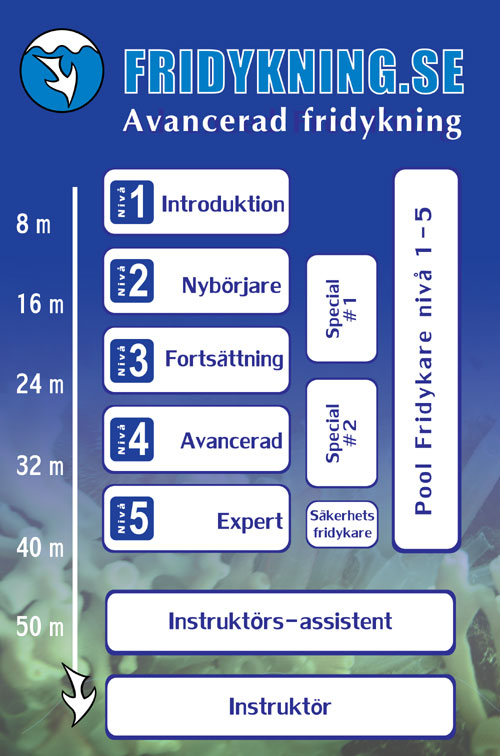
BEGINNER – LEVEL 2
Two days – 12 hours (No prerequisites whatsoever except that you can equalize your ears in a pool) Stretching based on yoga principles. Relaxation and oxygen-saving techniques, different breathing patterns before and after a freedive. “Hook breathing”. Maximum breath holds on land. Equalization techniques, duck diving, weighting, fin technique. Diving along a line, buddy system. SWBO, LMC and BTT theory and practice. Hydrodynamics. Modified breathing techniques from yoga. Rescue exercises. Theoretical test.
CONTINUATION – LEVEL 3
Two days – 12 hours Review from the beginner course. Summary of science around freediving. LMC and BO descriptions, as well as BTT technique. Yoga sessions. Preparation for advanced equalization techniques. Possibly Variable Weight dives to a maximum of 30 meters. Fine tuning of fin technique and hydrodynamics. Freefall. Breathing according to yoga principles. New equipment. Use of safety line, buddy system with rescue and BTT. Exercises where CO2 values are manipulated. Theoretical test. Diving from platform.
ADVANCED – LEVEL 4
2 days – 12 hours Latest findings within science around freediving. Proper yoga sessions, with breathing and relaxation and focus exercises. Advanced equalization techniques (frenzel and BTV (including mouthfill)). Lung packing. Variable weight diving to a maximum of 40 meters. Equipment testing. Sports psychology: affirmations, NLP, visualizations. Theory around FRC dives. Practical negative dives as warm-up. Negative lung packing. Personal training schedules and discussion around diet. Deep buddy rescue. Deep stress tests. Focus on relaxation and style. Theoretical test.
At Hästekasen Farm in Bohuslän (adventure center, fantasy village, permaculture, farming, natural building). Theme: Self-sufficiency.
You can see it as an active weekend getaway, we can call it a course, or why not a practical workshop. We can say it’s about experiencing nature at a farm between the sea and the forest. It will likely be a cure—a small mental “detox.” You’ll participate in various practical farm tasks, get a taste of what old-fashioned agriculture and forestry might have been like. You’ll get soil on your hands and an understanding of what a cycle is. A practical study in ecology.
We’ll discuss nature’s place in today’s society, the future of cities in a scenario where cheap energy is running out, and where humans have irreversibly changed nature and diminished their own quality of life. We’ll talk about food quality after harvesting and cooking with produce from the farm. We’ll discuss self-sufficiency in the city and in the countryside. Do your children a favor—bring them along.
Location
90 km north of Gothenburg, accommodation on the farm.
Fee
1,800 SEK (includes food and lodging—bring your own bedding) Contact Participants: 8 + farm volunteers Food: Vegetarian
Theory and Possible Practical Activities Outdoors:
Foraging mushrooms
Composting & soil work (1 hour)
Cultivation school: Terra preta & biochar production (1 hour)
Sowing seeds (1 hour)
Shearing sheep (1 hour)
Slaughtering lamb
Wool handling (1 hour)
Felling trees & barking (1 hour)
Simple clay cube wall (2 hours)
Baking, fermenting vegetables (2 hours)
Carving a wooden ladle (1 hour)
Making torches and stearin candles (2 hours)
Making apple juice
Making herb salt
Introduction to permaculture
Bonfire
Baking in a clay oven
Drying fruit
Apple jam
Music jam
Blacksmithing
Advanced bread baking with ancient ecological grains
We adapt to the weather. We’ll make a bonfire, we’ll get lost in the forest. We’ll start the day with yoga-inspired exercises or a walk (before breakfast).
We’ll also have the opportunity to sell our own products, which will be presented on-site.